

E. H. Carr: Imperialism, War and Lessons for Post-Colonial IR
E. H. Carr: Imperialism, War and Lessons for Post-Colonial IR
Paperback
Couldn't load pickup availability
Join our rewards scheme and earn reward points on this purchase!
Earn points on this!
Sign in or Sign up!- Release Date: 27/04/2023
- Barcode: 9783030993627
- Genre: Society & Culture
- Sub-Genre: Politics & Government
- Imprint: Springer Nature
- Publisher: Springer
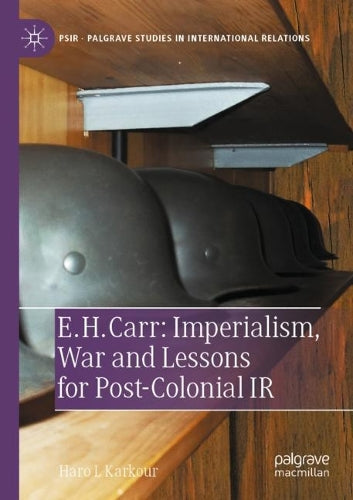

E. H. Carr: Imperialism, War and Lessons for Post-Colonial IR
Reprint
Couldn't load pickup availability
Collapsible content
DESCRIPTION
This book highlights important parallels between Carr and three influential figures in the first wave of post-colonialism—DuBois, Césaire and Fanon—on the analysis of imperialism and the causes of war. This book highlights important parallels between Carr and three influential figures in the first wave of post-colonialism—DuBois, Césaire and Fanon—on the analysis of imperialism and the causes of war. Specifically, Carr’s analysis of imperialism and war parallels the first wave post-colonial thinkers in two respects. First, Carr’s work historically situates imperialism in the context of the social question in Western democracies. Second, Carr’s work provides an ideology critique to Enlightenment rationalism, which postulates that ‘reason could determine what [are] the universally valid moral laws’ and thus ‘by the voice of reason men could be persuaded both to save their own immoral souls and to move along the path of political enlightenment and progress’ (Carr 1984, 22 and 24). Carr’s ideology critique exposes the Enlightenment’s pretences of reason and universality as a deceptive plea that legitimates imperialism. These parallels, the book argues, reveal that Carr didnot only recognise global hierarchy, but also theorised the role of what Julian Go refers to as the ‘episteme of empire’—that is, ‘the meanings and modalities of seeing and knowing that … accompanied empire and made it possible in the first place’ (Go 2017, 19–20). Carr’s IR theory, in short, was much closer to post-colonial thinking than previously appreciated in the discipline.
DELIVERY & RETURNS
UK Delivery:
- Free delivery on all orders of £10 or more.
- £1.49 delivery fee on orders below £10.
- UK orders are shipped via Royal Mail 2nd Class.
International Delivery:
- Flat rate delivery charges vary by country.
Dispatch and Delivery Times:
- All orders are shipped from our warehouse in Northampton, UK within 48 hours of receipt during working hours.
- UK mainland orders typically arrive within 3-5 working days via Royal Mail 2nd Class.
- International estimated delivery times:
- Europe & Channel Islands: 7 to 10 working days
- USA: 7 to 15 working days
- Rest of the World: 9 to 21 working days
View our full delivery infomation here.
-
OVER
2 MILLION PRODUCTS
-
60 MILLION CUSTOMERS
ACROSS 190 COUNTRIES
You might also like
Loading recommendations...