

Epistemic Processes
Epistemic Processes
A Basis for Statistics and Quantum Theory
Paperback
Couldn't load pickup availability
Join our rewards scheme and earn reward points on this purchase!
Earn points on this!
Sign in or Sign up!- Release Date: 16/10/2022
- Barcode: 9783030819255
- Genre: Science Nature & Math
- Imprint: Springer Nature
- Publisher: Springer
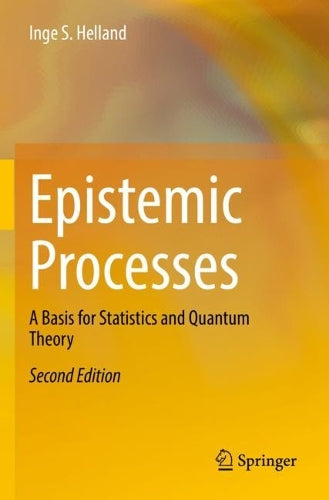

Epistemic Processes
Second Edition 2021
Couldn't load pickup availability
Collapsible content
DESCRIPTION
A Basis for Statistics and Quantum Theory This book discusses a link between statistical theory and quantum theory based on the concept of epistemic processes. The latter are processes, such as statistical investigations or quantum mechanical measurements, that can be used to obtain knowledge about something. Various topics in quantum theory are addressed, including the construction of a Hilbert space from reasonable assumptions and an interpretation of quantum states. Separate derivations of the Born formula and the one-dimensional Schrödinger equation are given. In concrete terms, a Hilbert space can be constructed under some technical assumptions associated with situations where there are two conceptual variables that can be seen as maximally accessible. Then to every accessible conceptual variable there corresponds an operator on this Hilbert space, and if the variables take a finite number of values, the eigenspaces/eigenvectors of these operators correspond to specific questions in nature together with sharp answers to these questions. This paves a new way to the foundations of quantum theory.
This paves a new way to the foundations of quantum theory.The resulting interpretation of quantum mechanics is related to Hervé Zwirn's recent Convivial Solipsism, but it also has some relations to Quantum Bayesianism and to Rovelli's relational quantum mechanics.
The book will benefit a broad readership, including physicists and statisticians interested in the foundations of their disciplines, philosophers of science and graduate students, and anyone with a reasonably good background in mathematics and an open mind.
DELIVERY & RETURNS
UK Delivery:
- Free delivery on all orders of £10 or more.
- £1.49 delivery fee on orders below £10.
- UK orders are shipped via Royal Mail 2nd Class.
International Delivery:
- Flat rate delivery charges vary by country.
Dispatch and Delivery Times:
- All orders are shipped from our warehouse in Northampton, UK as soon as stock is available.
- UK mainland orders typically arrive within 3-7 working days via Royal Mail 2nd Class.
- International estimated delivery times:
- Europe & Channel Islands: 7 to 10 working days
- USA: 7 to 15 working days
- Rest of the World: 9 to 30 working days
View our full delivery infomation here.
-
OVER
2 MILLION PRODUCTS
-
60 MILLION CUSTOMERS
ACROSS 190 COUNTRIES
You might also like
Loading recommendations...