

From Mimetic Translation to Artistic Transduction
From Mimetic Translation to Artistic Transduction
Hardback
Couldn't load pickup availability
Join our rewards scheme and earn reward points on this purchase!
Earn points on this!
Sign in or Sign up!- Release Date: 03/10/2023
- Barcode: 9781839989087
- Genre: Literary Criticism
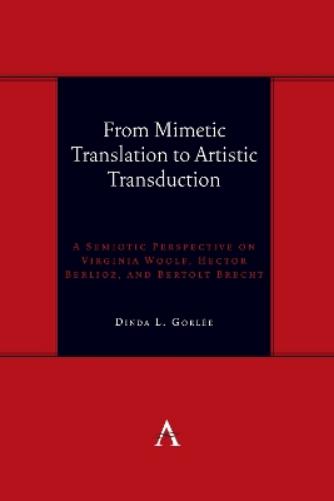

From Mimetic Translation to Artistic Transduction
Couldn't load pickup availability
Collapsible content
DESCRIPTION
A Semiotic Perspective on Virginia Woolf, Hector Berlioz, and Bertolt Brecht. Literary translation can be retranslated into new ways of thinking about music and the other arts. In artistic transduction, Woolf called the word the poetical cry, Berlioz the singing lyric, and Brecht the rhyming slang. Roman Jakobson gave a literary translation of the double words and concepts of poetical hyper translation. Language can transmit verbal translation to explore new ways of thinking about music and other arts. Thomas A. Sebeok deconstructed the energy of translation into the duplicated genres of artistic transduction. In semiotics, transduction is a technical expression involving music, theater, and other arts. Jakobson used Saussure’s theory to give a single meaning in a different art but with other words and sounds, later followed by Peirce’s dynamic energy with a floating sensation of the double meaning of words and concepts. For semiotician Peirce, literary translation becomes the graphical vision of ellipsis, parabole, and hyperbole. Ellipsis is illustrated by Virginia Woolf’s novel The Waves to give a political transformation of Wagner’s opera Das Rheingold. Parabole is illustrated by the two lines of thought of Hector Berlioz. He neglected his own translation of Virgil’s Aeneid, when he retranslated the vocal text to accompany the musical lyrics of his opera The Trojans. Hyperbole is demonstrated by Bertold Brecht’s auto-translation of Gay’s The Beggar’s Opera. In the cabaret theater of The Three penny Opera, Brecht recreated his epic hyper-translation by retranslating the language of the folk speech of the German working classes with the jargon of criminal slang.
ADDITIONAL DETAILS
DELIVERY & RETURNS
UK Delivery:
- Free delivery on all orders of £10 or more.
- £1.49 delivery fee on orders below £10.
- UK orders are shipped via Royal Mail 2nd Class.
International Delivery:
- Flat rate delivery charges vary by country.
Dispatch and Delivery Times:
- All orders are shipped from our warehouse in Northampton, UK within 48 hours of receipt during working hours.
- UK mainland orders typically arrive within 3-5 working days via Royal Mail 2nd Class.
- International estimated delivery times:
- Europe & Channel Islands: 7 to 10 working days
- USA: 7 to 15 working days
- Rest of the World: 9 to 21 working days
View our full delivery infomation here.
-
OVER
2 MILLION PRODUCTS
-
60 MILLION CUSTOMERS
ACROSS 190 COUNTRIES
You might also like
Loading recommendations...