

Cluster Algebra Structures on Poisson Nilpotent Algebras
Cluster Algebra Structures on Poisson Nilpotent Algebras
Paperback
Couldn't load pickup availability
Join our rewards scheme and earn reward points on this purchase!
Earn points on this!
Sign in or Sign up!- Release Date: 31/01/2024
- Barcode: 9781470467357
- Imprint: American Mathematical Society
- Publisher: American Mathematical Society
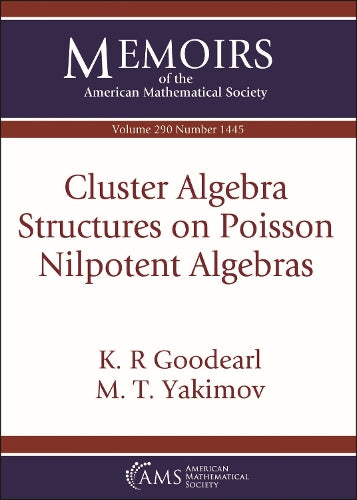

Cluster Algebra Structures on Poisson Nilpotent Algebras
Couldn't load pickup availability
Collapsible content
DESCRIPTION
All Poisson nilpotent algebras are proved to be equivariant Poisson Unique Factorization Domains. Their seeds are constructed from sequences of Poisson-prime elements for chains of Poisson UFDs; mutation matrices are effectively determined from linear systems in terms of the underlying Poisson structure.
Various coordinate rings of varieties appearing in the theory of Poisson Lie groups and Poisson homogeneous spaces belong to the large, axiomatically defined class of symmetric Poisson nilpotent algebras, e.g. coordinate rings of Schubert cells for symmetrizable Kac–Moody groups, affine charts of Bott-Samelson varieties, coordinate rings of double Bruhat cells (in the last case after a localization). We prove that every symmetric Poisson nilpotent algebra satisfying a mild condition on certain scalars is canonically isomorphic to a cluster algebra which coincides with the corresponding upper cluster algebra, without additional localizations by frozen variables. The constructed cluster structure is compatible with the Poisson structure in the sense of Gekhtman, Shapiro and Vainshtein. All Poisson nilpotent algebras are proved to be equivariant Poisson Unique Factorization Domains. Their seeds are constructed from sequences of Poisson-prime elements for chains of Poisson UFDs; mutation matrices are effectively determined from linear systems in terms of the underlying Poisson structure. Uniqueness, existence, mutation, and other properties are established for these sequences of Poisson-prime elements.
DELIVERY & RETURNS
UK Delivery:
- Free delivery on all orders of £10 or more.
- £1.49 delivery fee on orders below £10.
- UK orders are shipped via Royal Mail 2nd Class.
International Delivery:
- Flat rate delivery charges vary by country.
Dispatch and Delivery Times:
- All orders are shipped from our warehouse in Northampton, UK as soon as stock is available.
- UK mainland orders typically arrive within 3-7 working days via Royal Mail 2nd Class.
- International estimated delivery times:
- Europe & Channel Islands: 7 to 10 working days
- USA: 7 to 15 working days
- Rest of the World: 9 to 30 working days
View our full delivery infomation here.
-
OVER
2 MILLION PRODUCTS
-
60 MILLION CUSTOMERS
ACROSS 190 COUNTRIES
You might also like
Loading recommendations...