

Complex Analysis and Spectral Theory
Complex Analysis and Spectral Theory
Paperback
Couldn't load pickup availability
Join our rewards scheme and earn reward points on this purchase!
Earn points on this!
Sign in or Sign up!- Release Date: 30/03/2020
- Barcode: 9781470446925
- Imprint: American Mathematical Society
- Publisher: American Mathematical Society
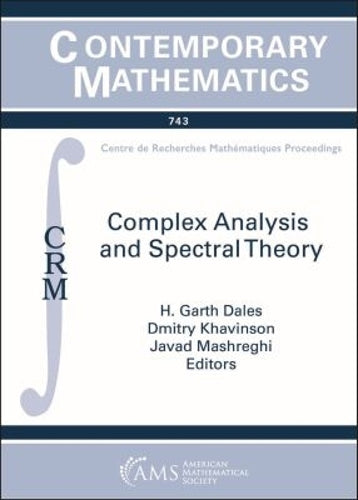

Complex Analysis and Spectral Theory
Couldn't load pickup availability
Collapsible content
DESCRIPTION
Contains the proceedings of the Conference on Complex Analysis and Spectral Theory, held in May 2018, at Laval University, Quebec. Spectral theory is the branch of mathematics devoted to the study of matrices and their eigenvalues, as well as their infinite-dimensional counterparts, linear operators and their spectra.
This volume contains the proceedings of the Conference on Complex Analysis and Spectral Theory, in celebration of Thomas Ransford's 60th birthday, held from May 21-25, 2018, at Laval University, Quebec, Canada.
Spectral theory is the branch of mathematics devoted to the study of matrices and their eigenvalues, as well as their infinite-dimensional counterparts, linear operators and their spectra. Spectral theory is ubiquitous in science and engineering because so many physical phenomena, being essentially linear in nature, can be modelled using linear operators. On the other hand, complex analysis is the calculus of functions of a complex variable. They are widely used in mathematics, physics, and in engineering. Both topics are related to numerous other domains in mathematics as well as other branches of science and engineering. The list includes, but is not restricted to, analytical mechanics, physics, astronomy (celestial mechanics), geology (weather modeling), chemistry (reaction rates), biology, population modeling, economics (stock trends, interest rates and the market equilibrium price changes).
There are many other connections, and in recent years there has been a tremendous amount of work on reproducing kernel Hilbert spaces of analytic functions, on the operators acting on them, as well as on applications in physics and engineering, which arise from pure topics like interpolation and sampling. Many of these connections are discussed in articles included in this book.
ADDITIONAL DETAILS
DELIVERY & RETURNS
UK Delivery:
- Free delivery on all orders of £10 or more.
- £1.49 delivery fee on orders below £10.
- UK orders are shipped via Royal Mail 2nd Class.
International Delivery:
- Flat rate delivery charges vary by country.
Dispatch and Delivery Times:
- All orders are shipped from our warehouse in Northampton, UK within 48 hours of receipt during working hours.
- UK mainland orders typically arrive within 3-5 working days via Royal Mail 2nd Class.
- International estimated delivery times:
- Europe & Channel Islands: 7 to 10 working days
- USA: 7 to 15 working days
- Rest of the World: 9 to 21 working days
View our full delivery infomation here.
-
OVER
2 MILLION PRODUCTS
-
60 MILLION CUSTOMERS
ACROSS 190 COUNTRIES
You might also like
Loading recommendations...