

An Army Afire
An Army Afire
How the US Army Confronted Its Racial Crisis in the Vietnam Era
Hardback
Couldn't load pickup availability
Join our rewards scheme and earn reward points on this purchase!
Earn points on this!
Sign in or Sign up!- Release Date: 02/05/2023
- Barcode: 9781469673264
- Genre: Society & Culture
- Sub-Genre: Social & Ethical Issues
- Imprint: University of North Carolina Press
- Publisher: The University of North Carolina Press
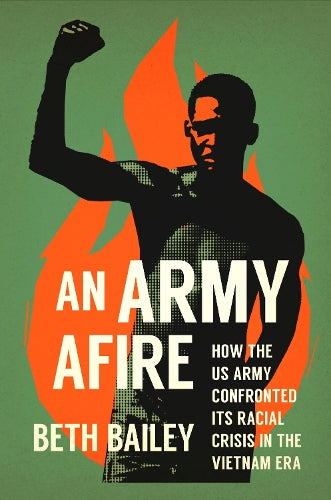

An Army Afire
Couldn't load pickup availability
Collapsible content
DESCRIPTION
How the US Army Confronted Its Racial Crisis in the Vietnam Era
Acclaimed military historian Beth Bailey shows how the US Army experienced, defined, and tried to solve racism and racial tension (in its own words, ‘the problem of race’) in the Vietnam War era.
By the Tet Offensive in early 1968, what had been widely heralded as the best qualified, best-trained army in US history was descending into crisis as the Vietnam War raged without end. Morale was tanking. AWOL rates were rising. And in August of that year, a group of Black soldiers seized control of the infamous Long Binh Jail, burned buildings, and beat a white inmate to death with a shovel. The days of "same mud, same blood" were over, and by the end of the decade, a new generation of Black GIs had decisively rejected the slights and institutional racism their forefathers had endured.
Acclaimed military historian Beth Bailey shows how the Army experienced, defined, and tried to solve racism and racial tension (in its own words, "the problem of race") in the Vietnam War era. Some individuals were sympathetic to the problem but offered solutions that were more performative than transformational, while others proposed remedies that were antithetical to the army's fundamental principles of discipline, order, hierarchy, and authority. Bailey traces a frustrating yet fascinating arc where the army initially rushed to create solutions without taking the time to fully identify the origins, causes, and proliferation of racial tension. It was a difficult, messy process, but only after Army leaders ceased viewing the issue as a Black issue and accepted their own roles in contributing to the problem did change become possible.
DELIVERY & RETURNS
UK Delivery:
- Free delivery on all orders of £10 or more.
- £1.49 delivery fee on orders below £10.
- UK orders are shipped via Royal Mail 2nd Class.
International Delivery:
- Flat rate delivery charges vary by country.
Dispatch and Delivery Times:
- All orders are shipped from our warehouse in Northampton, UK as soon as stock is available.
- UK mainland orders typically arrive within 3-7 working days via Royal Mail 2nd Class.
- International estimated delivery times:
- Europe & Channel Islands: 7 to 10 working days
- USA: 7 to 15 working days
- Rest of the World: 9 to 30 working days
View our full delivery infomation here.
-
OVER
2 MILLION PRODUCTS
-
60 MILLION CUSTOMERS
ACROSS 190 COUNTRIES
You might also like
Loading recommendations...