

The Millennium Maritime Trade Revolution, 700-1700
The Millennium Maritime Trade Revolution, 700-1700
How Asia Lost Maritime Supremacy
Hardback
Couldn't load pickup availability
Join our rewards scheme and earn reward points on this purchase!
Earn points on this!
Sign in or Sign up!- Release Date: 15/12/2023
- Barcode: 9781399060127
- Genre: Non-Fiction
- Sub-Genre: Business & Finance
- Publisher: Pen & Sword Books
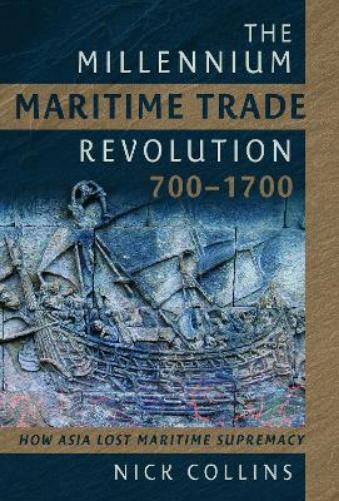

The Millennium Maritime Trade Revolution, 700-1700
Couldn't load pickup availability
Collapsible content
DESCRIPTION
How Asia Lost Maritime Supremacy
Second book in a 3-book series showing how maritime trade has been the principle driver of our world story from the deepest antiquity to the present.; Bespeaks extremely wide reading, careful research and a lot of thought well written, comprehensive and informative' - Alfons van der Kraan
Following the series' first book How Maritime Trade and the Indian Subcontinent Shaped the World, this book continues to demonstrate how maritime trade has been the key driver of the world's wealth-creation, economic and intellectual progress. The story begins where the first book ends, when following Roman Empire collapse, 7th-century European maritime trade almost ceased, creating population collapse and poverty; the Dark Ages. In 700 stuttering, hesitant recovery was evident with new ports but Viking and Muslim maritime raiding neutered recovery until the 11th century. In Asia by contrast, short and long-haul trade thrived and accelerated from east Africa and the Persian Gulf all the way to China, encouraging Southeast Asian state formation. The book tells the story of slowly rising, gradually accelerating European maritime trade, which until the 15th century was overshadowed by far more voluminous Asian trade in much larger, more complex ships traded by more sophisticated commercial entities, contributing to innovative tolerant wealth-creating maritime societies. In Europe, Mediterranean maritime trade made most progress from about 1000 to 1450,. But by 1700 north Europeans dominated Atlantic, American and Mediterranean trade and were penetrating sophisticated Asian maritime networks, a complete reversal. This book explains how and why and how destructive continental influences destroyed Asia's maritime supremacy. As in the first book, Nick Collins finds similar patterns; maritime inquisitiveness, invention, problem-solving and toleration and continental political suppression of those maritime traits, most dramatically in China, but destructively everywhere, allowing the millennium maritime trade revolution.
DELIVERY & RETURNS
UK Delivery:
- Free delivery on all orders of £10 or more.
- £1.49 delivery fee on orders below £10.
- UK orders are shipped via Royal Mail 2nd Class.
International Delivery:
- Flat rate delivery charges vary by country.
Dispatch and Delivery Times:
- All orders are shipped from our warehouse in Northampton, UK within 48 hours of receipt during working hours.
- UK mainland orders typically arrive within 3-5 working days via Royal Mail 2nd Class.
- International estimated delivery times:
- Europe & Channel Islands: 7 to 10 working days
- USA: 7 to 15 working days
- Rest of the World: 9 to 21 working days
View our full delivery infomation here.
-
OVER
2 MILLION PRODUCTS
-
60 MILLION CUSTOMERS
ACROSS 190 COUNTRIES
You might also like
Loading recommendations...