

The Origins and Evolution of Consumer Capitalism
The Origins and Evolution of Consumer Capitalism
A Veblenian-Keynesian Perspective
Paperback
Couldn't load pickup availability
Join our rewards scheme and earn reward points on this purchase!
Earn points on this!
Sign in or Sign up!- Release Date: 11/04/2023
- Barcode: 9781138335462
- Genre: Business & Finance
- Imprint: Routledge
- Publisher: Taylor & Francis
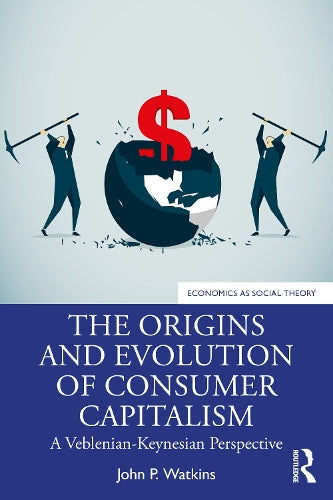

The Origins and Evolution of Consumer Capitalism
Couldn't load pickup availability
Collapsible content
DESCRIPTION
A Veblenian-Keynesian Perspective Consumer capitalism arose with the second-industrial revolution, the application of continuous-mass production to consumer goods during the late nineteenth and early twentieth centuries. Consumer capitalism arose with the second industrial revolution, the application of continuous-mass production to consumer goods during the late nineteenth and early twentieth centuries. This book adopts a Veblenian, Keynesian viewpoint, presenting an evolutionary view of consumption combined with the need to increase demand to match increases in production. The book traces the history of consumer capitalism, examining the paradox posed by applying continuous-mass production to produce armaments for dynastic ambitions versus consumer goods for the masses, manifesting itself in the world wars of the twentieth century. Multiple paradoxes at the heart of the story address booms leading to busts, over-producing countries in Asia relying on over-consuming countries in the West, and the expansion of demand depending on increasingly inventive ways of liquefying assets, in light of stagnant incomes. The book persuasively argues that these paradoxes result from capitalism’s incessant drive to accumulate capital, fostering conflict, crises, and depression. The latest paradox results from the impact of continuous-mass production on the environment, manifesting itself as the Darwinian dilemma. The dilemma stems from human beings largely winning the struggle for existence and, in the process, possibly making the earth uninhabitable, at least for humans.
DELIVERY & RETURNS
UK Delivery:
- Free delivery on all orders of £10 or more.
- £1.49 delivery fee on orders below £10.
- UK orders are shipped via Royal Mail 2nd Class.
International Delivery:
- Flat rate delivery charges vary by country.
Dispatch and Delivery Times:
- All orders are shipped from our warehouse in Northampton, UK as soon as stock is available.
- UK mainland orders typically arrive within 3-7 working days via Royal Mail 2nd Class.
- International estimated delivery times:
- Europe & Channel Islands: 7 to 10 working days
- USA: 7 to 15 working days
- Rest of the World: 9 to 30 working days
View our full delivery infomation here.
-
OVER
2 MILLION PRODUCTS
-
60 MILLION CUSTOMERS
ACROSS 190 COUNTRIES
You might also like
Loading recommendations...