

Best Fit Lines & Curves
Best Fit Lines & Curves
And Some Mathe-Magical Transformations
Paperback
Couldn't load pickup availability
Join our rewards scheme and earn reward points on this purchase!
Earn points on this!
Sign in or Sign up!- Release Date: 01/04/2025
- Barcode: 9781032948515
- Imprint: Routledge
- Publisher: Taylor & Francis
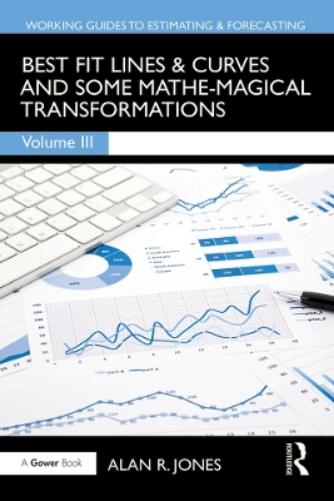

Best Fit Lines & Curves
Couldn't load pickup availability
Collapsible content
DESCRIPTION
And Some Mathe-Magical Transformations The text considers Simple Linear Regression and ask what is it doing? how good is it? how accurate is it? and how can we use it to create estimates? The book considers all this and looks at how you can exploit this transformability and use the capability of Simple Linear Regression. Best Fit Lines and Curves, and Some Mathe-Magical Transformations (Volume III of the Working Guides to Estimating & Forecasting series) concentrates on techniques for finding the Best Fit Line or Curve to some historical data allowing us to interpolate or extrapolate the implied relationship that will underpin our prediction. A range of simple ‘Moving Measures’ are suggested to smooth the underlying trend and quantify the degree of noise or scatter around that trend. The advantages and disadvantages are discussed and a simple way to offset the latent disadvantage of most Moving Measure Techniques is provided. Simple Linear Regression Analysis, a more formal numerical technique that calculates the line of best fit subject to defined ‘goodness of fit’ criteria. Microsoft Excel is used to demonstrate how to decide whether the line of best fit is a good fit, or just a solution in search of some data. These principles are then extended to cover multiple cost drivers, and how we can use them to quantify 3-Point Estimates. With a deft sleight of hand, certain commonly occurring families of non-linear relationships can be transformed mathe-magically into linear formats, allowing us to exploit the powers of Regression Analysis to find the Best Fit Curves. The concludes with an exploration of the ups and downs of seasonal data (Time Series Analysis). Supported by a wealth of figures and tables, this is a valuable resource for estimators, engineers, accountants, project risk specialists as well as students of cost engineering.
DELIVERY & RETURNS
UK Delivery:
- Free delivery on all orders of £10 or more.
- £1.49 delivery fee on orders below £10.
- UK orders are shipped via Royal Mail 2nd Class.
International Delivery:
- Flat rate delivery charges vary by country.
Dispatch and Delivery Times:
- All orders are shipped from our warehouse in Northampton, UK within 48 hours of receipt during working hours.
- UK mainland orders typically arrive within 3-5 working days via Royal Mail 2nd Class.
- International estimated delivery times:
- Europe & Channel Islands: 7 to 10 working days
- USA: 7 to 15 working days
- Rest of the World: 9 to 21 working days
View our full delivery infomation here.
-
OVER
2 MILLION PRODUCTS
-
60 MILLION CUSTOMERS
ACROSS 190 COUNTRIES
You might also like
Loading recommendations...