

Postmodern Moments in Modern Economics
Postmodern Moments in Modern Economics
Paperback
Couldn't load pickup availability
Join our rewards scheme and earn 102 reward points on this purchase!
Earn 102 points on this!
Sign in or Sign up!- Release Date: 28/06/2016
- Barcode: 9780691171005
- Genre: Non-Fiction
- Sub-Genre: Business & Finance
- Imprint: Princeton University Press
- Publisher: Princeton University Press
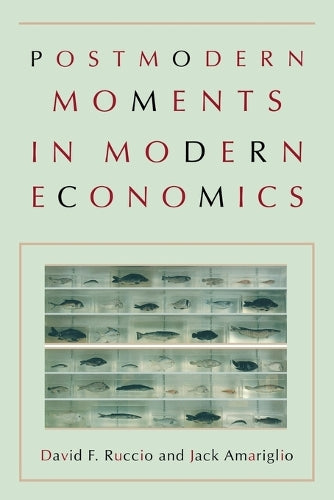

Postmodern Moments in Modern Economics
Couldn't load pickup availability
Collapsible content
DESCRIPTION
Of all the areas of contemporary thought, economics seems the most resistant to the destabilizing effects of postmodernism. Yet, David Ruccio and Jack Amariglio argue that one can detect, within the diverse schools of thought that comprise the discipline of economics, "moments" that defy the modernist ideas to which many economists and methodologis
Of all the areas of contemporary thought, economics seems the most resistant to the destabilizing effects of postmodernism. Yet, David Ruccio and Jack Amariglio argue that one can detect, within the diverse schools of thought that comprise the discipline of economics, "moments" that defy the modernist ideas to which many economists and methodologists remain wedded. This is the first book to document the existence and to explore the implications of the postmodern moments in modern economics. Ruccio and Amariglio begin with a powerful argument for the general relevance of postmodernism to contemporary economic thought. They then conduct a series of case studies in six key areas of economics. From the idea of the "multiple self" and notions of uncertainty and information, through market anomalies and competing concepts of value, to analytical distinctions based on gender and academic standing, economics is revealed as defying the modernist frame of a singular science. The authors conclude by showing how economic theory would change if the postmodern elements were allowed to flourish.A work of daring analysis sure to be vigorously debated, Postmodern Moments in Modern Economics is both accessible and relevant to all readers concerned about the modernist straightjacket that has been imposed on the way economics is thought about and practiced in the world today.
DELIVERY & RETURNS
UK Delivery:
- Free delivery on all orders of £10 or more.
- £1.49 delivery fee on orders below £10.
- UK orders are shipped via Royal Mail 2nd Class.
International Delivery:
- Flat rate delivery charges vary by country.
Dispatch and Delivery Times:
- All orders are shipped from our warehouse in Northampton, UK within 48 hours of receipt during working hours.
- UK mainland orders typically arrive within 3-5 working days via Royal Mail 2nd Class.
- International estimated delivery times:
- Europe & Channel Islands: 7 to 10 working days
- USA: 7 to 15 working days
- Rest of the World: 9 to 21 working days
View our full delivery infomation here.
-
OVER
2 MILLION PRODUCTS
-
60 MILLION CUSTOMERS
ACROSS 190 COUNTRIES
You might also like
Loading recommendations...