

A Progress of Sentiments
A Progress of Sentiments
Reflections on Hume’s Treatise
Paperback
Couldn't load pickup availability
Join our rewards scheme and earn reward points on this purchase!
Earn points on this!
Sign in or Sign up!- Release Date: 01/04/1991
- Barcode: 9780674713864
- Genre: Philosophy & Spirituality
- Sub-Genre: Theology
- Imprint: Harvard University Press
- Publisher: Harvard University Press
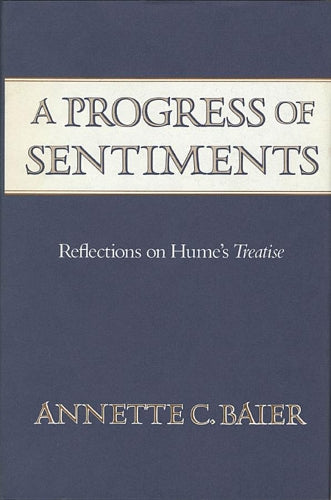

A Progress of Sentiments
Couldn't load pickup availability
Collapsible content
DESCRIPTION
Reflections on Hume’s Treatise
Baier aims to make sense of Hume's Treatise as a whole. Hume’s family motto was “True to the End.” Baier argues that it is not until the end of the Treatise that we get his full story about “truth and falsehood, reason and folly.” By the end, we can see the cause to which Hume has been true throughout the work.
Annette Baier’s aim is to make sense of David Hume’s Treatise as a whole. Hume’s family motto, which appears on his bookplate, was “True to the End.” Baier argues that it is not until the end of the Treatise that we get his full story about “truth and falsehood, reason and folly.” By the end, we can see the cause to which Hume has been true throughout the work.Baier finds Hume’s Treatise on Human Nature to be a carefully crafted literary and philosophical work which itself displays a philosophical progress of sentiments. His starting place is an overly abstract intellectualism that deliberately thrusts passions and social concerns into the background. In the three interrelated books of the Treatise, his “self-understander” proceeds through partial successes and dramatic failures to emerge with new-found optimism, expecting that the “exact knowledge” the morally self-conscious anatomist of human nature can acquire will itself improve and correct our vision of morality. Baier describes how, by turning philosophy toward human nature instead of toward God and the universe, Hume initiated a new philosophy, a broader discipline of reflection that can embrace Charles Darwin and Michel Foucault as well as William James and Sigmund Freud. Hume belongs both to our present and to our past.
ADDITIONAL DETAILS
DELIVERY & RETURNS
UK Delivery:
- Free delivery on all orders of £10 or more.
- £1.49 delivery fee on orders below £10.
- UK orders are shipped via Royal Mail 2nd Class.
International Delivery:
- Flat rate delivery charges vary by country.
Dispatch and Delivery Times:
- All orders are shipped from our warehouse in Northampton, UK within 48 hours of receipt during working hours.
- UK mainland orders typically arrive within 3-5 working days via Royal Mail 2nd Class.
- International estimated delivery times:
- Europe & Channel Islands: 7 to 10 working days
- USA: 7 to 15 working days
- Rest of the World: 9 to 21 working days
View our full delivery infomation here.
-
OVER
2 MILLION PRODUCTS
-
60 MILLION CUSTOMERS
ACROSS 190 COUNTRIES
You might also like
Loading recommendations...