

How the Workers Became Muslims
How the Workers Became Muslims
Immigration, Culture, and Hegemonic Transformation in Europe
Paperback
Couldn't load pickup availability
Join our rewards scheme and earn reward points on this purchase!
Earn points on this!
Sign in or Sign up!- Release Date: 22/02/2016
- Barcode: 9780472053087
- Genre: Society & Culture
- Sub-Genre: Politics & Government
- Imprint: University of Michigan Press
- Publisher: The University of Michigan Press
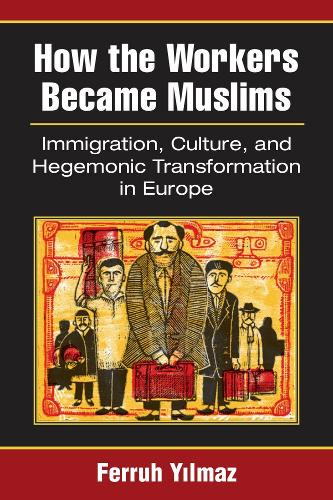

How the Workers Became Muslims
Couldn't load pickup availability
Collapsible content
DESCRIPTION
Immigration, Culture, and Hegemonic Transformation in Europe An exploration of immigration, and how European far right groups attract seemingly left populations by emphasizing culture over economics Writing in the beginning of the 1980s, Ernesto Laclau and Chantal Mouffe explored possibilities for a new socialist strategy to capitalize on the period’s fragmented political and social conditions. Two and a half decades later, Ferruh Yilmaz acknowledges that the populist Far Right—not the socialist movement—has demonstrated greater facility in adopting successful hegemonic strategies along new structural lines Laclau and Mouffe imagined. Right-wing hegemonic strategy, Yilmaz argues, has led to the reconfiguration of internal fault lines in European societies.
Yilmaz’s primary case study is Danish immigration discourse, but his argument contextualizes his study in terms of questions of current concern across Europe, where right-wing groups that were long on the fringes of “legitimate” politics have managed to make significant gains with populations traditionally aligned with the Left. Specifically, Yilmaz argues that sociopolitical space has been transformed in the last three decades such that group classification has been destabilized to emphasize cultural rather than economic attributes.
According to this point-of-view, traditional European social and political splits are jettisoned for new “cultural” alliances pulling the political spectrum to the right, against the “corrosive” presence of Muslim immigrants, whose own social and political variety is flattened into an illusion of alien sameness.
DELIVERY & RETURNS
UK Delivery:
- Free delivery on all orders of £10 or more.
- £1.49 delivery fee on orders below £10.
- UK orders are shipped via Royal Mail 2nd Class.
International Delivery:
- Flat rate delivery charges vary by country.
Dispatch and Delivery Times:
- All orders are shipped from our warehouse in Northampton, UK within 48 hours of receipt during working hours.
- UK mainland orders typically arrive within 3-5 working days via Royal Mail 2nd Class.
- International estimated delivery times:
- Europe & Channel Islands: 7 to 10 working days
- USA: 7 to 15 working days
- Rest of the World: 9 to 21 working days
View our full delivery infomation here.
-
OVER
2 MILLION PRODUCTS
-
60 MILLION CUSTOMERS
ACROSS 190 COUNTRIES
You might also like
Loading recommendations...