

Ableist Rhetoric
Ableist Rhetoric
Hardback
Couldn't load pickup availability
Join our rewards scheme and earn reward points on this purchase!
Earn points on this!
Sign in or Sign up!- Release Date: 22/10/2019
- Barcode: 9780271084688
- Genre: Language & Reference
- Imprint Family: Pennsylvania State University Press
- Publisher: Pennsylvania State University Press
- Subgenre: Social Sciences
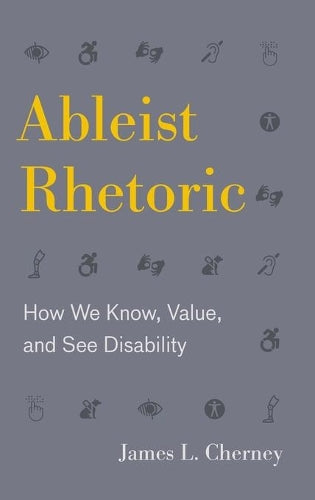

Ableist Rhetoric
Couldn't load pickup availability
Collapsible content
DESCRIPTION
How We Know, Value, and See Disability Examines the rhetorical practices that generate and sustain discrimination against disabled people. Demonstrates how ableist values, knowledge, and ways of seeing pervade Western culture and influence social institutions such as law, sport, and religion. Ableism, a form of discrimination that elevates “able” bodies over those perceived as less capable, remains one of the most widespread areas of systematic and explicit discrimination in Western culture. Yet in contrast to the substantial body of scholarly work on racism, sexism, classism, and heterosexism, ableism remains undertheorized and underexposed. In this book, James L. Cherney takes a rhetorical approach to the study of ableism to reveal how it has worked its way into our everyday understanding of disability. Ableist Rhetoric argues that ableism is learned and transmitted through the ways we speak about those with disabilities. Through a series of textual case studies, Cherney identifies three rhetorical norms that help illustrate the widespread influence of ableist ideas in society. He explores the notion that “deviance is evil” by analyzing the possession narratives of Cotton Mather and the modern horror touchstone The Exorcist. He then considers whether “normal is natural” in Aristotle’s Generation of Animals and in the cultural debate over cochlear implants. Finally, he shows how the norm “body is able” operates in Alexander Graham Bell’s writings on eugenics and in the legal cases brought by disabled athletes Casey Martin and Oscar Pistorius. These three simple equivalencies play complex roles within the social institutions of religion, medicine, law, and sport. Cherney concludes by calling for a rhetorical model of disability, which, he argues, will provide a shift in orientation to challenge ableism’s epistemic, ideological, and visual components. Accessible and compelling, this groundbreaking book will appeal to scholars of rhetoric and of disability studies as well as to disability rights advocates.
DELIVERY & RETURNS
UK Delivery:
- Free delivery on all orders of £10 or more.
- £1.49 delivery fee on orders below £10.
- UK orders are shipped via Royal Mail 2nd Class.
International Delivery:
- Flat rate delivery charges vary by country.
Dispatch and Delivery Times:
- All orders are shipped from our warehouse in Northampton, UK as soon as stock is available.
- UK mainland orders typically arrive within 3-7 working days via Royal Mail 2nd Class.
- International estimated delivery times:
- Europe & Channel Islands: 7 to 10 working days
- USA: 7 to 15 working days
- Rest of the World: 9 to 30 working days
View our full delivery infomation here.
-
OVER
2 MILLION PRODUCTS
-
60 MILLION CUSTOMERS
ACROSS 190 COUNTRIES
You might also like
Loading recommendations...