

Prophetic Maharaja
Prophetic Maharaja
Loss, Sovereignty, and the Sikh Tradition in Colonial South Asia
Hardback
Couldn't load pickup availability
Join our rewards scheme and earn reward points on this purchase!
Earn points on this!
Sign in or Sign up!- Release Date: 10/09/2024
- Barcode: 9780231214483
- Imprint: Columbia University Press
- Publisher: Columbia University Press
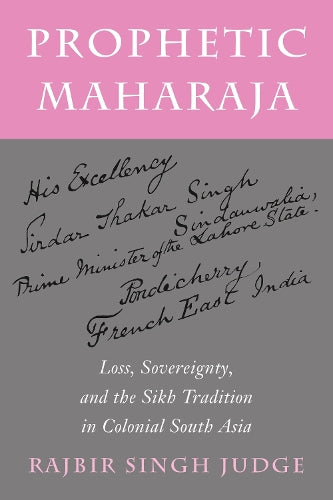

Prophetic Maharaja
Couldn't load pickup availability
Collapsible content
DESCRIPTION
Loss, Sovereignty, and the Sikh Tradition in Colonial South Asia
Rajbir Singh Judge offers new ways to understand loss and the limits of history by considering Maharaja Duleep Singh and his struggle during the 1880s to reestablish Sikh rule, the lost Khalsa Raj, in Punjab.
Winner, 2025 Best First Book in the History of Religions, American Academy of Religion
Finalist, 2025 Award for Excellence in the Study of Religion: Analytical-Descriptive Studies, American Academy of Religion
How do traditions and peoples grapple with loss, particularly when it is of such magnitude that it defies the possibility of recovery or restoration? Rajbir Singh Judge offers new ways to understand loss and the limits of history by considering Maharaja Duleep Singh and his struggle during the 1880s to reestablish Sikh rule, the lost Khalsa Raj, in Punjab.
Sikh sovereignty in what is today northern India and northeastern Pakistan came to an end in the middle of the nineteenth century, when the British annexed the Sikh kingdom and, eventually, exiled its child maharaja, Duleep Singh, to England. In the 1880s, Singh embarked on an abortive attempt to restore the lost Sikh kingdom. Judge explores not only Singh’s efforts but also the Sikh people’s responses—the dreams, fantasies, and hopes that became attached to the Khalsa Raj. He shows how a community engaged military, political, and psychological loss through theological debate, literary production, bodily discipline, and ethical practice in order to contest colonial politics. This book argues that Sikhs in the final decades of the nineteenth century were not simply looking to recuperate the past but to remake it—and to dwell within loss instead of transcending it—and in so doing opened new possibilities.
Bringing together Sikh tradition, psychoanalysis, and postcolonial thought, Prophetic Maharaja provides bracing insights into concepts of sovereignty and the writing of history.
DELIVERY & RETURNS
UK Delivery:
- Free delivery on all orders of £10 or more.
- £1.49 delivery fee on orders below £10.
- UK orders are shipped via Royal Mail 2nd Class.
International Delivery:
- Flat rate delivery charges vary by country.
Dispatch and Delivery Times:
- All orders are shipped from our warehouse in Northampton, UK within 48 hours of receipt during working hours.
- UK mainland orders typically arrive within 3-5 working days via Royal Mail 2nd Class.
- International estimated delivery times:
- Europe & Channel Islands: 7 to 10 working days
- USA: 7 to 15 working days
- Rest of the World: 9 to 21 working days
View our full delivery infomation here.
-
OVER
2 MILLION PRODUCTS
-
60 MILLION CUSTOMERS
ACROSS 190 COUNTRIES
You might also like
Loading recommendations...