

Nostalgic Virility As a Cause of War
Nostalgic Virility As a Cause of War
How Leaders of Great Powers Cope with Status Decline
Paperback
Couldn't load pickup availability
Join our rewards scheme and earn reward points on this purchase!
Earn points on this!
Sign in or Sign up!- Release Date: 12/03/2024
- Barcode: 9780228020363
- Genre: Society & Culture
- Sub-Genre: Politics & Government
- Imprint: McGill-Queen's University Press
- Publisher: McGill-Queen's University Press
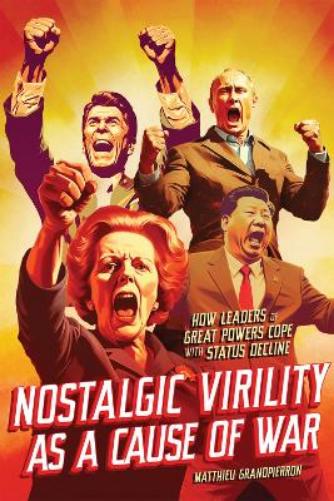

Nostalgic Virility As a Cause of War
Couldn't load pickup availability
Collapsible content
DESCRIPTION
How Leaders of Great Powers Cope with Status Decline Why do great powers go to war? Why are non-violent, diplomatic options not prioritized? Nostalgic Virility as a Cause of War argues that world leaders react to status decline by going to war, guided by a nostalgic, virile understanding of what it means to be powerful. This nostalgic virility – a system of subjective beliefs about power, bravery, strength, morality, and health – acts as a filter through which leaders articulate glorified interpretations of history and assess their power and their country's status on the international stage. In this rigorous study of France, the United Kingdom, and the United States, Matthieu Grandpierron tests the theory of nostalgic virility against the two more common theoretical frameworks of realism and the diversionary theory of war. Consulting thousands of newly declassified government documents at the highest levels of decision making, Grandpierron examines three specific cases – the early years of the Indochina War (1945–47), the British reconquest of the Falklands in 1982, and the US invasion of Grenada in 1983 – convincingly contending that status-seeking behaviour and nostalgic virility are more relevant in explaining why a leader chooses war and conflict over non-violent, diplomatic options than the dominant frameworks. Looking to the recent past, Nostalgic Virility as a Cause of War considers how this new model can be applied to current conflicts – from the Russian war in Ukraine to Chinese actions in the South China Sea – and provides surprising ways of thinking about the relationship between power, decision makers, and causes of war.
Matthieu Grandpierron presents new ways of thinking about power politics and military intervention in an unstable world. Consulting newly declassified documents at the highest levels of decision-making, Grandpierron uses the framework of nostalgic virility to provide surprising ways of thinking about current conflicts, from the Russian war in Ukraine to Chinese actions in the South China Sea.
DELIVERY & RETURNS
UK Delivery:
- Free delivery on all orders of £10 or more.
- £1.49 delivery fee on orders below £10.
- UK orders are shipped via Royal Mail 2nd Class.
International Delivery:
- Flat rate delivery charges vary by country.
Dispatch and Delivery Times:
- All orders are shipped from our warehouse in Northampton, UK within 48 hours of receipt during working hours.
- UK mainland orders typically arrive within 3-5 working days via Royal Mail 2nd Class.
- International estimated delivery times:
- Europe & Channel Islands: 7 to 10 working days
- USA: 7 to 15 working days
- Rest of the World: 9 to 21 working days
View our full delivery infomation here.
-
OVER
2 MILLION PRODUCTS
-
60 MILLION CUSTOMERS
ACROSS 190 COUNTRIES
You might also like
Loading recommendations...