

Environment and Statecraft
Environment and Statecraft
The Strategy of Environmental Treaty-Making
Paperback
Couldn't load pickup availability
Join our rewards scheme and earn 126 reward points on this purchase!
Earn 126 points on this!
Sign in or Sign up!- Release Date: 10/11/2005
- Barcode: 9780199286096
- Imprint: Oxford University Press
- Publisher: Oxford University Press
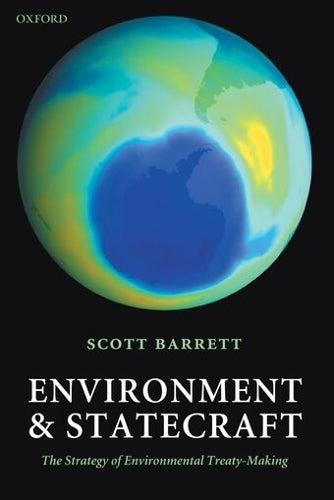

Environment and Statecraft
Couldn't load pickup availability
Collapsible content
DESCRIPTION
The Strategy of Environmental Treaty-Making
How did the Montreal Protocol succeed in protecting the earth's ozone layer? Why will the Kyoto Protocol fail to materially dampen global climate change? Are treaties really needed? This book develops a theory to answer these questions - one that integrates the approaches used in economics, political science, international law, and game theory.
Environmental problems like global climate change and stratospheric ozone depletion can only be remedied if states cooperate with one another. But sovereign states usually care only about their own interests. So states must somehow restructure the incentives to make cooperation pay. This is what treaties are meant to do. A few treaties, such as the Montreal Protocol on Substances that Deplete the Ozone Layer, succeed. Most, however, fail to alter the state behaviour appreciably. This book develops a theory that explains both the successes and the failures. In particular, the book explains when treaties are needed, why some work better than others, and how treaty design can be improved. The best treaties strategically manipulate the incentives states have to exploit the environment, and the theory developed in this book shows how treaties can do this. The theory integrates a number of disciplines, including economics, political science, international law, negotiation analysis, and game theory. It also offers a coherent and consistent approach. The essential assumption is that treaties be self-enforcing-that is, individually rational, collectively rational, and fair. The book applies the theory to a number of environmental problems. It provides information on more than three hundred treaties, and analyses a number of case studies in detail. These include depletion of the ozone layer, whaling, pollution of the Rhine, acid rain, over-fishing, pollution of the oceans, and global climate change. The essential lesson of the book is that treaties should not just tell countries what to do. Treaties must make it in the interests of countries to behave differently. That is, they must restructure the underlying game. Most importantly, they must create incentives for states to participate in a treaty and for parties to comply.
DELIVERY & RETURNS
UK Delivery:
- Free delivery on all orders of £10 or more.
- £1.49 delivery fee on orders below £10.
- UK orders are shipped via Royal Mail 2nd Class.
International Delivery:
- Flat rate delivery charges vary by country.
Dispatch and Delivery Times:
- All orders are shipped from our warehouse in Northampton, UK within 48 hours of receipt during working hours.
- UK mainland orders typically arrive within 3-5 working days via Royal Mail 2nd Class.
- International estimated delivery times:
- Europe & Channel Islands: 7 to 10 working days
- USA: 7 to 15 working days
- Rest of the World: 9 to 21 working days
View our full delivery infomation here.
-
OVER
2 MILLION PRODUCTS
-
60 MILLION CUSTOMERS
ACROSS 190 COUNTRIES
You might also like
Loading recommendations...