

Immiserizing Growth Fails the Poor
Immiserizing Growth Fails the Poor
Theory and Empirical Research
Hardback
Couldn't load pickup availability
Join our rewards scheme and earn reward points on this purchase!
Earn points on this!
Sign in or Sign up!- Release Date: 22/02/2024
- Barcode: 9780192870056
- Genre: Non-Fiction
- Sub-Genre: Business & Finance
- Imprint: Oxford University Press
- Publisher: Oxford University Press
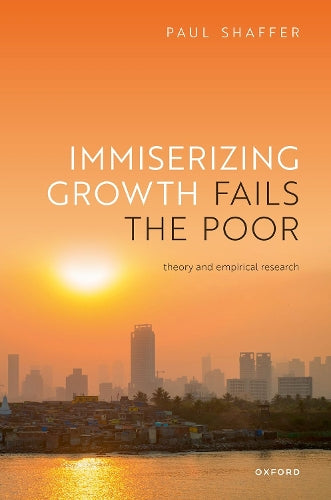

Immiserizing Growth Fails the Poor
Couldn't load pickup availability
Collapsible content
DESCRIPTION
Theory and Empirical Research
Immiserizing Growth presents a conceptualization of immiserizing growth which combines the notions of failed and malevolent inclusion, being bypassed, and 'avoidably' harmed by growth, respectively.
Immiserizing Growth Fails the Poor refers to situations where economic growth does not lead to poverty reduction. How should this phenomenon be conceptualized? How often, when, and where does it occur? Why does it occur? Shaffer addresses these three sets of questions drawing on a wide range of theoretical perspectives and empirical approaches.This volume presents a conceptualization of immiserizing growth which combines the notions of failed and malevolent inclusion, being bypassed, and 'avoidably' harmed by growth, respectively. It develops this concept of malevolent inclusion drawing on a debate in philosophy about 'doing and allowing harm'. The analysis proceeds to examine the characteristics and causes of immiserizing growth on the basis of comparable household survey data from the 1990s using multiple poverty lines and time periods, and different measures of growth and poverty.The book also explores theories, processes, and mechanisms of immiserizing growth found in a wide variety of bodies of thought including the classical tradition of political economy (Mathus, Ricardo, and Marx), more recent radical traditions of scholarship, literatures on poverty dynamics, and inclusive growth and empirical case studies. It proceeds to empirically investigate some of the variables uncovered in this literature using cross-country econometric techniques, methods of qualitative comparative analysis and case-studies from sub-Saharan Africa, matched using cluster analysis and situated within a typological framework.
DELIVERY & RETURNS
UK Delivery:
- Free delivery on all orders of £10 or more.
- £1.49 delivery fee on orders below £10.
- UK orders are shipped via Royal Mail 2nd Class.
International Delivery:
- Flat rate delivery charges vary by country.
Dispatch and Delivery Times:
- All orders are shipped from our warehouse in Northampton, UK as soon as stock is available.
- UK mainland orders typically arrive within 3-7 working days via Royal Mail 2nd Class.
- International estimated delivery times:
- Europe & Channel Islands: 7 to 10 working days
- USA: 7 to 15 working days
- Rest of the World: 9 to 30 working days
View our full delivery infomation here.
-
OVER
2 MILLION PRODUCTS
-
60 MILLION CUSTOMERS
ACROSS 190 COUNTRIES
You might also like
Loading recommendations...