

Idealism in Modern Philosophy
Idealism in Modern Philosophy
Hardback
Couldn't load pickup availability
Join our rewards scheme and earn reward points on this purchase!
Earn points on this!
Sign in or Sign up!- Release Date: 23/03/2023
- Barcode: 9780192848574
- Genre: Philosophy & Spirituality
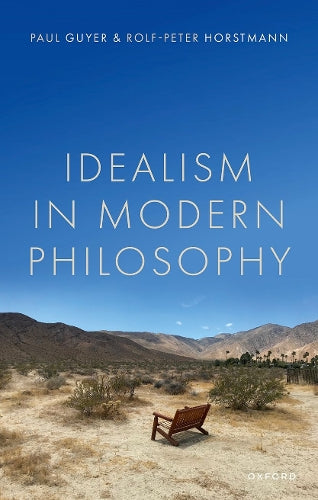

Idealism in Modern Philosophy
Couldn't load pickup availability
Collapsible content
DESCRIPTION
This book tells the story of idealism in modern philosophy, from the seventeenth century to the turn of the twenty-first. Guyer and Horstmann discuss many philosophers who have played a role in the development of idealism, including Descartes, Hobbes, Spinoza, Leibniz, Locke, Berkeley, Hume, Kant, Hegel, Schopenhauer, Nietzsche, and Wittgenstein.
This book tells the story of idealism in modern philosophy, from the seventeenth century to the turn of the twenty-first. Paul Guyer and Rolf-Peter Horstmann define idealism as the reduction of all reality to something mental in nature. Rather than distinguishing between metaphysical and epistemological versions of idealism, they distinguish between metaphysical and epistemological motivations for idealism. They argue that while metaphysical arguments for idealism have only rarely been accepted, for example by Bishop Berkeley in the early eighteenth century and the British idealists Bradley and McTaggart in the late nineteenth and early twentieth centuries, epistemological arguments for idealism have been widely accepted, even in the so-called analytic philosophy of the twentieth century.Guyer and Horstmann discuss many philosophers who have played a role in the development of idealism, from Descartes, Hobbes, Spinoza, Leibniz, Locke, Berkeley, and Hume, through Kant; the German idealists Fichte, Schelling, and Hegel; Schopenhauer and Nietzsche; the British and American idealists such as Green and Royce in addition to Bradley and McTaggart; G.E. Moore and Bertrand Russell, Neo-Kantians such as Ernst Cassirer; and twentieth-century philosophers such as Wittgenstein, Collingwood, Carnap, Sellars, and McDowell.
DELIVERY & RETURNS
UK Delivery:
- Free delivery on all orders of £10 or more.
- £1.49 delivery fee on orders below £10.
- UK orders are shipped via Royal Mail 2nd Class.
International Delivery:
- Flat rate delivery charges vary by country.
Dispatch and Delivery Times:
- All orders are shipped from our warehouse in Northampton, UK as soon as stock is available.
- UK mainland orders typically arrive within 3-7 working days via Royal Mail 2nd Class.
- International estimated delivery times:
- Europe & Channel Islands: 7 to 10 working days
- USA: 7 to 15 working days
- Rest of the World: 9 to 30 working days
View our full delivery infomation here.
-
OVER
2 MILLION PRODUCTS
-
60 MILLION CUSTOMERS
ACROSS 190 COUNTRIES
You might also like
Loading recommendations...