

Social Dimensions of Moral Responsibility
Social Dimensions of Moral Responsibility
Hardback
Couldn't load pickup availability
Join our rewards scheme and earn reward points on this purchase!
Earn points on this!
Sign in or Sign up!- Release Date: 19/04/2018
- Barcode: 9780190609610
- Genre: Society & Culture
- Subgenre: Gender Sex & Relationships
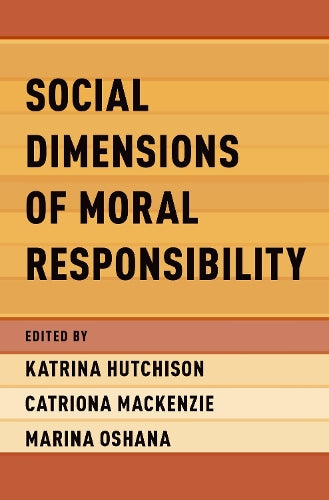

Social Dimensions of Moral Responsibility
Couldn't load pickup availability
Collapsible content
DESCRIPTION
The essays in this volume open up reflection on the implications of social inequality for theorizing about moral responsibility. Collectively, they focus attention on the relevance of the social context, and of structural and epistemic injustice, stereotyping and implicit bias, for critically analyzing our moral responsibility practices. To what extent are we responsible for our actions? Philosophical theorizing about this question has recently taken a social turn, marking a shift in focus from traditional metaphysical concerns about free will and determinism. Recent theories have attended to the interpersonal dynamics at the heart of moral responsibility practices and the role of the moral environment in scaffolding agency. Yet, the implications of social inequality and the role of social power for our moral responsibility practices remains a surprisingly neglected topic. The conception of agency involved in current approaches to moral responsibility is overly idealized, assuming that our practices involve interactions between equally empowered and situated agents. In twelve new essays and a substantial introduction, this volume systematically challenges this assumption, exploring the impact of social factors such as power relationships and hierarchies, paternalism, socially constructed identities, race, gender and class on moral responsibility. Social factors have bearing on the circumstances in which agents act as well as on the person or people in the position to hold that agent accountable for his or her action. Additionally, social factors bear on the parties who pass judgment on the agent. Leading theorists of moral responsibility, including Michael McKenna, Marina Oshana, and Manuel Vargas, consider the implications of oppression and structural inequality for their respective theories. Neil Levy urges the need to refocus our analyses of the epistemic and control conditions for moral responsibility from individual to socially extended agents. Leading theorists of relational autonomy, including Catriona Mackenzie, Natalie Stoljar and Andrea Westlund develop new insights into the topic of moral responsibility. Other contributors bring debates about moral responsibility into dialogue with recent work in feminist philosophy, social epistemology and social psychology on topics such as epistemic injustice and implicit bias. Collectively, the essays in this volume reorient philosophical debates about moral responsibility in important new directions.
DELIVERY & RETURNS
UK Delivery:
- Free delivery on all orders of £10 or more.
- £1.49 delivery fee on orders below £10.
- UK orders are shipped via Royal Mail 2nd Class.
International Delivery:
- Flat rate delivery charges vary by country.
Dispatch and Delivery Times:
- All orders are shipped from our warehouse in Northampton, UK within 48 hours of receipt during working hours.
- UK mainland orders typically arrive within 3-5 working days via Royal Mail 2nd Class.
- International estimated delivery times:
- Europe & Channel Islands: 7 to 10 working days
- USA: 7 to 15 working days
- Rest of the World: 9 to 21 working days
View our full delivery infomation here.
-
OVER
2 MILLION PRODUCTS
-
60 MILLION CUSTOMERS
ACROSS 190 COUNTRIES
You might also like
Loading recommendations...