


Michel-Richard De Lalande: Music for the Sun King
Michel-Richard De Lalande: Music for the Sun King
CD
Couldn't load pickup availability
Join our rewards scheme and earn reward points on this purchase!
Earn points on this!
Sign in or Sign up!- Release Date: 01/10/2002
- Barcode: 0034571173252
- Duration: 72.09 minutes
- Edition: Album
- Genre: Classical
- Subgenre: Opera & Vocal

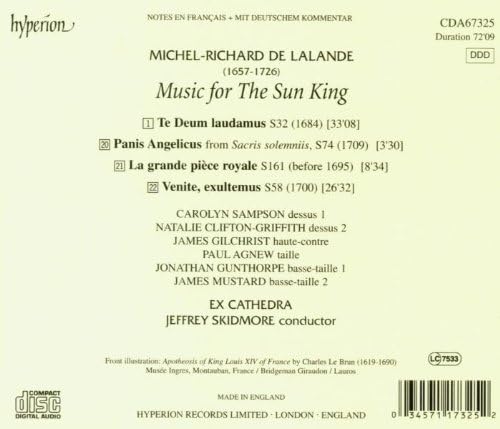

Michel-Richard De Lalande: Music for the Sun King
Album
Couldn't load pickup availability
Collapsible content
DESCRIPTION
PRODUCT DESCRIPTION
This resplendent CD introduces another outstanding 'early music' ensemble to HyperionJeffrey Skidmore's Ex Cathedra, who will explore some of the lesser-known Baroque byways for us. They make their entrance with this programme of music by one of the four composers assigned to Louis XIV's Chapel in 1683. The disc gives us the opportunity to hear two of Lalande's 'grands motets' in full (substantial, sectional works in which episodes for vocal soloists are interspersed with passages for small ensembles and chorus, the orchestra providing both accompaniment and interludes), as well as a solo movement extracted from another one, and one of his instrumental pieces. This is music which was highly regarded both in the composer's own day and beyond, and performed throughout the eighteenth century.
REVIEW
That Louis XIV: loved glamour, glitter and spending money like it was going out of style; hated High Mass. So while he splashed out on performers and composers to make music for just about everything that moved at Versailles, the Sun King needed something special for the Low Mass he preferred to attend in the royal chapel. And that's where Michel-Richard de Lalande came in; one of four composers appointed to his Majesty after a talent competition, Lalande became a royal favourite and prospered at court for over 43 years, long after Louis' death.
So, one of the young man's missions was to provide suitable music for the celebration of Mass the way the King wanted it, and Lalande perfected the grand motet that had been pioneered by his predecessor Henry du Mont: the priest read the liturgy and the music took the form of three motets tailored to the service, which could be up to a quarter of an hour in length.
Actually, they were sometimes longer. Jeffrey Skidmore and Ex Cathedra bring us a couple of specials: a Te Deum laudamus with celebratory trumpets and drums, which replaced a full mass setting (but lasted no longer, at the King's insistence), and the psalm setting Venite, exultemus. What a glorious mixture of pomp and piety, from fanfares to some fine expressive harmonies. Try the opening or ending of the Te Deum to gauge the impact of the full forces; the Panis Angelicus for the quality of soprano Carolyn Sampson's solo singing, and Venite, adoremus for the sheer beauty of the whole exercise, the music and the performances.
In terms of his reputation today Lalande suffers alongside Lully or Charpentier, yet as this disc shows us, in the right hands he really shouldn't: there's music here just as noble and profound, and any lover of baroque choral music will lap it up. --Andrew McGregor
Find more music at the BBC This link will take you off Amazon in a new window
ADDITIONAL DETAILS
DELIVERY & RETURNS
UK Delivery:
- Free delivery on all orders of £10 or more.
- £1.49 delivery fee on orders below £10.
- UK orders are shipped via Royal Mail 2nd Class.
International Delivery:
- Flat rate delivery charges vary by country.
Dispatch and Delivery Times:
- All orders are shipped from our warehouse in Northampton, UK as soon as stock is available.
- UK mainland orders typically arrive within 3-7 working days via Royal Mail 2nd Class.
- International estimated delivery times:
- Europe & Channel Islands: 7 to 10 working days
- USA: 7 to 15 working days
- Rest of the World: 9 to 30 working days
View our full delivery infomation here.
-
OVER
2 MILLION PRODUCTS
-
60 MILLION CUSTOMERS
ACROSS 190 COUNTRIES
You might also like
Loading recommendations...