

Linear Algebra with Python
Linear Algebra with Python
Theory and Applications
Hardback
Couldn't load pickup availability
Join our rewards scheme and earn reward points on this purchase!
Earn points on this!
Sign in or Sign up!- Release Date: 07/12/2023
- Barcode: 9789819929504
- Imprint: Springer
- Publisher: Springer
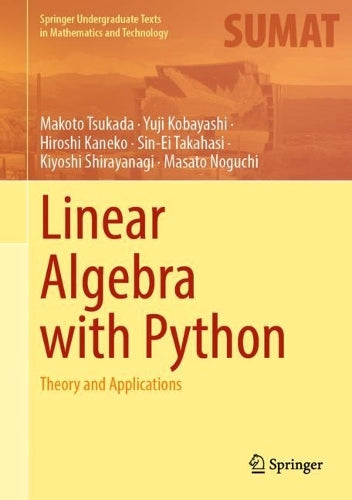

Linear Algebra with Python
Reprint
Couldn't load pickup availability
Collapsible content
DESCRIPTION
Theory and Applications
Advanced topics such as function space are taken up, along with Fourier analysis, the Perron–Frobenius theorem, linear differential equations, the state transition matrix and the generalized inverse matrix, singular value decomposition, tensor products, and linear regression models.
This textbook is for those who want to learn linear algebra from the basics. After a brief mathematical introduction, it provides the standard curriculum of linear algebra based on an abstract linear space. It covers, among other aspects: linear mappings and their matrix representations, basis, and dimension; matrix invariants, inner products, and norms; eigenvalues and eigenvectors; and Jordan normal forms. Detailed and self-contained proofs as well as descriptions are given for all theorems, formulas, and algorithms.
A unified overview of linear structures is presented by developing linear algebra from the perspective of functional analysis. Advanced topics such as function space are taken up, along with Fourier analysis, the Perron–Frobenius theorem, linear differential equations, the state transition matrix and the generalized inverse matrix, singular value decomposition, tensor products, and linear regression models. These all provide a bridge to more specialized theories based on linear algebra in mathematics, physics, engineering, economics, and social sciences.
Python is used throughout the book to explain linear algebra. Learning with Python interactively, readers will naturally become accustomed to Python coding. By using Python’s libraries NumPy, Matplotlib, VPython, and SymPy, readers can easily perform large-scale matrix calculations, visualization of calculation results, and symbolic computations. All the codes in this book can be executed on both Windows and macOS and also on Raspberry Pi.
Read more Continue reading Read less FROM THE BACK COVER
This textbook is for those who want to learn linear algebra from the basics. After a brief mathematical introduction, it provides the standard curriculum of linear algebra based on an abstract linear space. It covers, among other aspects: linear mappings and their matrix representations, basis, and dimension; matrix invariants, inner products, and norms; eigenvalues and eigenvectors; and Jordan normal forms. Detailed and self-contained proofs as well as descriptions are given for all theorems, formulas, and algorithms.
A unified overview of linear structures is presented by developing linear algebra from the perspective of functional analysis. Advanced topics such as function space are taken up, along with Fourier analysis, the Perron–Frobenius theorem, linear differential equations, the state transition matrix and the generalized inverse matrix, singular value decomposition, tensor products, and linear regression models. These all provide a bridge to more specialized theories based on linear algebra in mathematics, physics, engineering, economics, and social sciences.
Python is used throughout the book to explain linear algebra. Learning with Python interactively, readers will naturally become accustomed to Python coding. By using Python’s libraries NumPy, Matplotlib, VPython, and SymPy, readers can easily perform large-scale matrix calculations, visualization of calculation results, and symbolic computations. All the codes in this book can be executed on both Windows and macOS and also on Raspberry Pi.
ABOUT THE AUTHOR
Makoto Tsukada has been studied in the field of functional analysis. He has been teaching linear algebra, analysis, and probability theory for many years. Also, he has taught programming language courses using Pascal, Prolog, C, Python, etc. Yuji Kobayashi, Hiroshi Kaneko, Sin-Ei Takahasi, Kiyoshi Shirayanagi, and Masato Noguchi are specialists in algebra, analysis, statistics, and computers.
Read more Continue reading Read less
DELIVERY & RETURNS
UK Delivery:
- Free delivery on all orders of £10 or more.
- £1.49 delivery fee on orders below £10.
- UK orders are shipped via Royal Mail 2nd Class.
International Delivery:
- Flat rate delivery charges vary by country.
Dispatch and Delivery Times:
- All orders are shipped from our warehouse in Northampton, UK as soon as stock is available.
- UK mainland orders typically arrive within 3-7 working days via Royal Mail 2nd Class.
- International estimated delivery times:
- Europe & Channel Islands: 7 to 10 working days
- USA: 7 to 15 working days
- Rest of the World: 9 to 30 working days
View our full delivery infomation here.
-
OVER
2 MILLION PRODUCTS
-
60 MILLION CUSTOMERS
ACROSS 190 COUNTRIES
You might also like
Loading recommendations...