

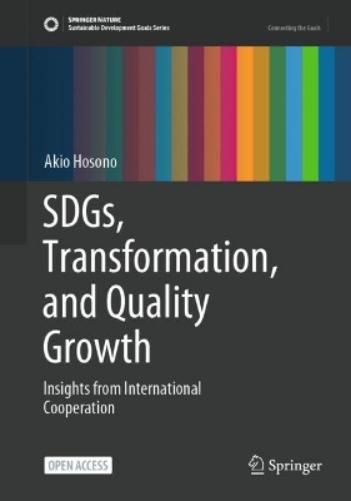
SDGs, Transformation, and Quality Growth
SDGs, Transformation, and Quality Growth
Insights from International Cooperation
Hardback
Couldn't load pickup availability
Join our rewards scheme and earn reward points on this purchase!
Earn points on this!
Sign in or Sign up!- Release Date: 02/03/2022
- Barcode: 9789811697470
- Genre: Non-Fiction
- Sub-Genre: Business & Finance
- Imprint: Springer
- Publisher: Springer

SDGs, Transformation, and Quality Growth
Standard Edition
Couldn't load pickup availability
Collapsible content
DESCRIPTION
Insights from International Cooperation This is an Open Access book. The primary objective of this book is to seek out insights into the concept of high-quality growth (HQG). It explores the essential attributes of HQG, such as inclusiveness, sustainability, and resilience, as well as its relationship with transformation, by drawing principally on illustrative cases and instances of international cooperation. The United Nations document on Sustainable Development Goals (SDGs) states that “We resolve to create conditions for sustainable, inclusive and sustained economic growth, shared prosperity and decent work for all.” As such, the concept of quality growth is inherent in many aspects of the SDGs. A similar approach can be seen in the Development Cooperation Charter announced by the Japanese government in 2015. According to the Charter, one of the most important challenges of development is quality growth and the reduction of poverty achieved through such growth. The approach in the Charter emphasizes inclusiveness, sustainability, and resilience. This volume is a pioneering study on quality growth as well as its relationship with SDGs and transformation. Comprehensive studies on quality growth are very few. The case study approach distinguishes the present volume from some previous literature that discussed quality growth within the framework of general policy. Instead, in this book, concrete cases and experiences provide insights into hands-on “ingredients”. Through the case studies, it can be seen more clearly that transformation and quality growth are phenomena that do not occur automatically but, rather, ones that require specific, properly designed strategies and approaches. Another unique feature of this book is that it aims to make explicit some of the consistent, but implicit, principles of Japan’s international cooperation.
The United Nations document on Sustainable Development Goals (SDGs) states that “We resolve to create conditions for sustainable, inclusive and sustained economic growth, shared prosperity and decent work for all.” As such, the concept of quality growth is inherent in many aspects of the SDGs.
DELIVERY & RETURNS
UK Delivery:
- Free delivery on all orders of £10 or more.
- £1.49 delivery fee on orders below £10.
- UK orders are shipped via Royal Mail 2nd Class.
International Delivery:
- Flat rate delivery charges vary by country.
Dispatch and Delivery Times:
- All orders are shipped from our warehouse in Northampton, UK within 48 hours of receipt during working hours.
- UK mainland orders typically arrive within 3-5 working days via Royal Mail 2nd Class.
- International estimated delivery times:
- Europe & Channel Islands: 7 to 10 working days
- USA: 7 to 15 working days
- Rest of the World: 9 to 21 working days
View our full delivery infomation here.
-
OVER
2 MILLION PRODUCTS
-
60 MILLION CUSTOMERS
ACROSS 190 COUNTRIES
You might also like
Loading recommendations...