

Covert Modality in Non-finite Contexts (Interface Explorations , 8
Covert Modality in Non-finite Contexts (Interface Explorations , 8
Hardback
Couldn't load pickup availability
Join our rewards scheme and earn reward points on this purchase!
Earn points on this!
Sign in or Sign up!- Release Date: 18/12/2006
- Barcode: 9783110179521
- Genre: Non-Fiction
- Sub-Genre: Language & Reference
- Imprint: De Gruyter Mouton
- Publisher: De Gruyter

Covert Modality in Non-finite Contexts (Interface Explorations , 8
1st
Couldn't load pickup availability
Collapsible content
DESCRIPTION
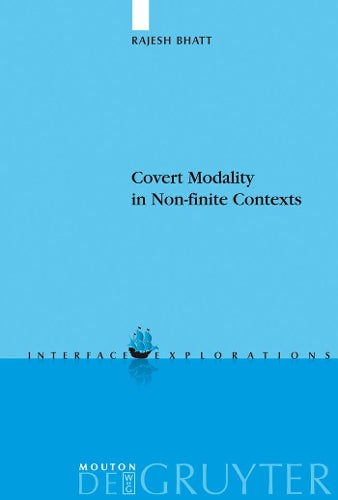
This book investigates the distribution and interpretation of Covert Modality. Covert Modality is modality which we interpret but which is not associated with any lexical item in the structure that we are interpreting. The book analyzes a class of environments that involves covert modality e.g. This book investigates the distribution and interpretation of Covert Modality. Covert Modality is modality which we interpret but which is not associated with any lexical item in the structure that we are interpreting. This dissertation investigates a class of environments that involves covert modality. Examples of covert modality include wh-infinitival complements, infinitival relative clauses, purpose clauses, the 'have to' construction, and the 'is to' construction (cf. 1): 1a. Tim knows [how to solve the problem]. ("Tim knows how one/he could/should solve the problem.") The interpretation of (1a-f) involves modality; however, there is no lexical item that seems to be the source of the modality. What (1a-f) have in common is that they involve infinitivals. This book addresses the following questions about covert modality: what is the source of this modality, what are its semantic properties, why are some but not all infinitival relatives modal, and why are all infinitival questions modal? The infinitival [+wh] Complementizer is identified as the source of the covert modality. The apparent variability of the force of this modality is related to the particular semantics of this Complementizer. Infinitival relatives that receive a non-modal interpretation are analyzed as being reduced relatives and thus not involving the infinitival [+wh] Complementizer.
1b. Jane found [a book to draw cartoons in] for Sara. ("Jane found a book for Sara one could/should draw cartoons in.")
1c. [The man to fix the sink] is here. ("The man whose purpose is to fix the sink is here.")
1d. Sue went to Torino [to buy a violin]. ("Sue went to Torino so that she could buy a violin.")
1e. Bill has to reach Philadelphia before noon. ("Bill must reach Philadelphia before noon.")
1f. Will is to leave tomorrow. ("Will is scheduled/supposed to leave tomorrow.")
DELIVERY & RETURNS
UK Delivery:
- Free delivery on all orders of £10 or more.
- £1.49 delivery fee on orders below £10.
- UK orders are shipped via Royal Mail 2nd Class.
International Delivery:
- Flat rate delivery charges vary by country.
Dispatch and Delivery Times:
- All orders are shipped from our warehouse in Northampton, UK as soon as stock is available.
- UK mainland orders typically arrive within 3-7 working days via Royal Mail 2nd Class.
- International estimated delivery times:
- Europe & Channel Islands: 7 to 10 working days
- USA: 7 to 15 working days
- Rest of the World: 9 to 30 working days
View our full delivery infomation here.
-
OVER
2 MILLION PRODUCTS
-
60 MILLION CUSTOMERS
ACROSS 190 COUNTRIES
You might also like
Loading recommendations...