

Teaching Silicon How to Feel
Teaching Silicon How to Feel
The Last Developer’s Guide to Everything That Matters
Paperback
Couldn't load pickup availability
Join our rewards scheme and earn reward points on this purchase!
Earn points on this!
Sign in or Sign up!- Release Date: 09/02/2026
- Barcode: 9781917251167
- Genre: Computing & The Internet
- Sub-Genre: Computer Science
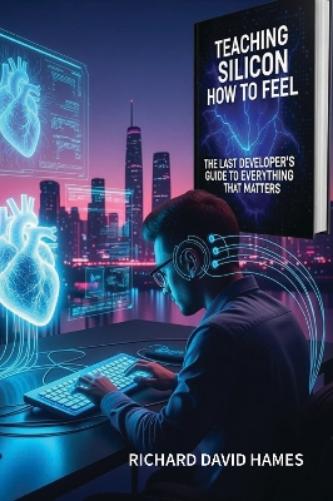

Teaching Silicon How to Feel
Couldn't load pickup availability
Collapsible content
DESCRIPTION
The Last Developer’s Guide to Everything That Matters Teaching Silicon How to Feel reframes the whole AIdebate at a stroke. Instead of asking “how do we stop machines from harmingus?” we need to ask “what have we already normalised as acceptable harm?”.Richard David Hames argues that contemporary AI is being trained on acivilisation, culture and history shaped by slavery, genocide, colonialism,factory farming, drone warfare and extractive capitalism – and that withoutdeliberate intervention, those patterns of cruelty and indifference will bequietly hard-wired into our most powerful systems. Organised around 17 theoretically ‘unresolvable’ catalysts –from The Inheritance of Cruelty and The Unseen Economies of Suffering to TheAlgorithm of Oblivion and The Fractal of Indifference – the book probes thedarkest angels of human nature. Drawing on philosophy, political and economichistory, trauma science and critical technology studies, Hames shows how ourinstitutions encode violence, how that violence shows up in data andinfrastructures, and why AI magnifies whatever we feed it. This is not another abstract ethics treatise or tech-doomprophecy. Each catalyst is paired with a ‘From Theory to Praxis’ section thatspeaks directly to people building and governing AI systems. Readers learn howto:
AI is being trained on a civilisation, culture and history shaped by slavery, genocide, colonialism, factory farming, drone warfare and extractive capitalism – without intervention, those patterns of cruelty and indifference will be quietly hard-wired into our most powerful systems.
Written in accessible, lucid prose for a generalaudience, Teaching Silicon How to Feel will also inform softwareengineers, machine learning practitioners, UX designers, policymakers,ethicists, systems thinkers and anyone alarmed by the speed and direction of AIdeployment. It offers a stark diagnosis of our current trajectory and aradical, practical invitation: to enlist AI as an ally in dismantling thehidden economies of suffering that have defined the worst of humancivilisation.
DELIVERY & RETURNS
UK Delivery:
- Free delivery on all orders of £10 or more.
- £1.49 delivery fee on orders below £10.
- UK orders are shipped via Royal Mail 2nd Class.
International Delivery:
- Flat rate delivery charges vary by country.
Dispatch and Delivery Times:
- All orders are shipped from our warehouse in Northampton, UK within 48 hours of receipt during working hours.
- UK mainland orders typically arrive within 3-5 working days via Royal Mail 2nd Class.
- International estimated delivery times:
- Europe & Channel Islands: 7 to 10 working days
- USA: 7 to 15 working days
- Rest of the World: 9 to 21 working days
View our full delivery infomation here.
-
OVER
2 MILLION PRODUCTS
-
60 MILLION CUSTOMERS
ACROSS 190 COUNTRIES
You might also like
Loading recommendations...