

Arbitrary Lagrangian Eulerian and Fluid-Structure Interaction
Arbitrary Lagrangian Eulerian and Fluid-Structure Interaction
Hardback
Couldn't load pickup availability
Join our rewards scheme and earn reward points on this purchase!
Earn points on this!
Sign in or Sign up!- Release Date: 15/01/2010
- Barcode: 9781848211315
- Genre: Technology & Engineering
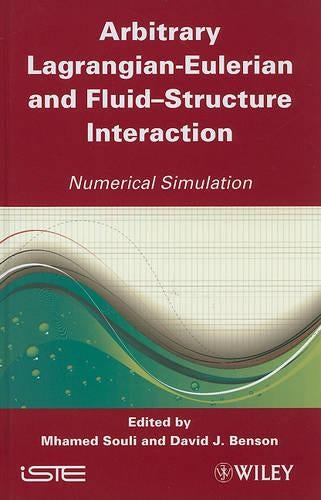

Arbitrary Lagrangian Eulerian and Fluid-Structure Interaction
Couldn't load pickup availability
Collapsible content
DESCRIPTION
Numerical Simulation This book provides the fundamental basics for solving fluid structure interaction problems, and describes different algorithms and numerical methods used to solve problems where fluid and structure can be weakly or strongly coupled. These approaches are illustrated with examples arising from industrial or academic applications. Each of these approaches has its own performance and limitations. The added mass technique is described first. Following this, for general coupling problems involving large deformation of the structure, the Navier-Stokes equations need to be solved in a moving mesh using an ALE formulation. The main aspects of the fluid structure coupling are then developed. The first and by far simplest coupling method is explicit partitioned coupling. In order to preserve the flexibility and modularity that are inherent in the partitioned coupling, we also describe the implicit partitioned coupling using an iterative process. In order to reduce computational time for large-scale problems, an introduction to the Proper Orthogonal Decomposition (POD) technique applied to FSI problems is also presented. To extend the application of coupling problems, mathematical descriptions and numerical simulations of multiphase problems using level set techniques for interface tracking are presented and illustrated using specific coupling problems. Given the book's comprehensive coverage, engineers, graduate students and researchers involved in the simulation of practical fluid structure interaction problems will find this book extremely useful.
This book provides the fundamental basics for solving fluid structure interaction problems, and describes different algorithms and numerical methods used to solve problems where fluid and structure can be weakly or strongly coupled. These approaches are illustrated with examples arising from industrial or academic applications.
DELIVERY & RETURNS
UK Delivery:
- Free delivery on all orders of £10 or more.
- £1.49 delivery fee on orders below £10.
- UK orders are shipped via Royal Mail 2nd Class.
International Delivery:
- Flat rate delivery charges vary by country.
Dispatch and Delivery Times:
- All orders are shipped from our warehouse in Northampton, UK within 48 hours of receipt during working hours.
- UK mainland orders typically arrive within 3-5 working days via Royal Mail 2nd Class.
- International estimated delivery times:
- Europe & Channel Islands: 7 to 10 working days
- USA: 7 to 15 working days
- Rest of the World: 9 to 21 working days
View our full delivery infomation here.
-
OVER
2 MILLION PRODUCTS
-
60 MILLION CUSTOMERS
ACROSS 190 COUNTRIES
You might also like
Loading recommendations...