

Pathologies of Body, Self and Space
Pathologies of Body, Self and Space
A Special Issue of Cognitive Neuropsychiatry
Hardback
Couldn't load pickup availability
Join our rewards scheme and earn reward points on this purchase!
Earn points on this!
Sign in or Sign up!- Release Date: 05/09/2002
- Barcode: 9781841699332
- Imprint: Routledge
- Publisher: Taylor & Francis
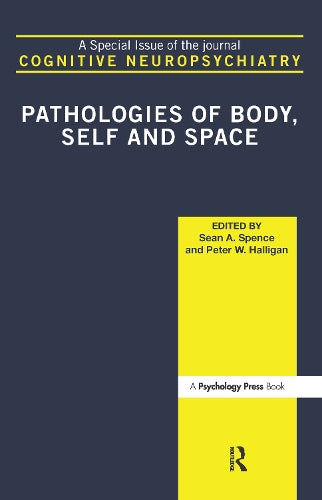

Pathologies of Body, Self and Space
Standard Edition
Couldn't load pickup availability
Collapsible content
DESCRIPTION
A Special Issue of Cognitive Neuropsychiatry In this special issue of Cognitive Neuropsychiatry, Spence and Halligan explore syndromes which arise with the dissociation of body and self, with contributions drawn from an internationally renowned panel of authors. What happens when the physical body and the subjective sense of self part company? How do we explain phantom limbs and alien abduction? What are the cognitive, neurobiological mechanisms that support such phenomena? In this special issue of Cognitive Neuropsychiatry, Spence and Halligan explore all these issues and more, with contributions drawn from an internationally renowned panel of authors, most of whom contributed to a symposium held in Sheffield, England in June 2001 ('The Neuropsychiatry of the Body in Space'). That meeting was primarily concerned with those bizarre and disturbing syndromes that arise when 'body' and 'self', soma and psyche are dissociated from each other, within or beyond the body's surface. Some disorders constrain the space of the body (as in neglect and dissociation syndromes), others seem to extend the boundaries (as with phantom limbs and autoscopy). Still others suggest a permeability of those boundaries (as in alien control and thought insertion, each occurring in schizophrenia). Finally, the body may itself be perceived as having passed into space, the most extreme exemplar being 'alien abduction'. Each paper contains a description of disturbed phenomenology and an account and critique of current cognitive neuropsychiatric findings.
ADDITIONAL DETAILS
DELIVERY & RETURNS
UK Delivery:
- Free delivery on all orders of £10 or more.
- £1.49 delivery fee on orders below £10.
- UK orders are shipped via Royal Mail 2nd Class.
International Delivery:
- Flat rate delivery charges vary by country.
Dispatch and Delivery Times:
- All orders are shipped from our warehouse in Northampton, UK within 48 hours of receipt during working hours.
- UK mainland orders typically arrive within 3-5 working days via Royal Mail 2nd Class.
- International estimated delivery times:
- Europe & Channel Islands: 7 to 10 working days
- USA: 7 to 15 working days
- Rest of the World: 9 to 21 working days
View our full delivery infomation here.
-
OVER
2 MILLION PRODUCTS
-
60 MILLION CUSTOMERS
ACROSS 190 COUNTRIES
You might also like
Loading recommendations...