

Two Late Umm an-Nar Tombs at Mowaihat-Ajman, United Arab Emirates
Two Late Umm an-Nar Tombs at Mowaihat-Ajman, United Arab Emirates
Excavations and Human Bone Remains
Paperback
Couldn't load pickup availability
Join our rewards scheme and earn reward points on this purchase!
Earn points on this!
Sign in or Sign up!- Release Date: 13/11/2025
- Barcode: 9781805831358
- Genre: History
- Sub-Genre: Archaeology
- Imprint: Archaeopress
- Publisher: Archaeopress

Two Late Umm an-Nar Tombs at Mowaihat-Ajman, United Arab Emirates
Couldn't load pickup availability
Collapsible content
DESCRIPTION
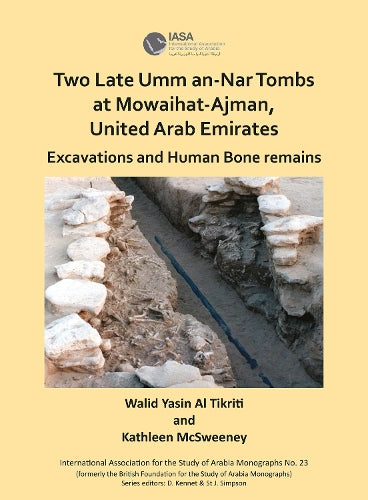
Excavations and Human Bone Remains Two Late Umm a-Nar Tombs at Mowaihat-Ajman, United Arab Emirates presents information resulting from rescue excavations at two collective tombs (A and B), belonging to the last quarter of the third millennium BC. The excavations at Tomb A, a disturbed above-ground, circular grave, and the diversity of the materials discovered in Tomb B, a rectangular subterranean pit-grave, in the mid-1980s, have confirmed that the sphere of the Umm an-Nar Culture in the United Arab Emirates is much wider than originally thought. Whilst Tomb A was fully excavated, Tomb B was only partially uncovered (Al Tikriti 1989). Excavation at the latter was completed by Late Ernie Haerinck (1991). The aim of this report is therefore to summarize the two preliminary published reports, and more importantly, to introduce an osteological study on the human bone remains from Tomb B. Since the discovery of the Umm an-Nar culture by the Danish Archaeological Expedition in the late 1950s, subterranean tombs of the period are still rare. Tomb N at Hili and Tomb B in Ajman are the only ones known so far. However, despite belonging to the same period and showing similarities in burial customs, the bone study of the Ajman remains demonstrated some differences between the dead of Tombs B and N.
This report details two Late Umm an-Nar tombs in Ajman, UAE, revealing a broader cultural reach. Tomb A was fully excavated; Tomb B, a rare subterranean grave, was later completed. An osteological study showed burial differences, offering new insights into third millennium BC practices.
DELIVERY & RETURNS
UK Delivery:
- Free delivery on all orders of £10 or more.
- £1.49 delivery fee on orders below £10.
- UK orders are shipped via Royal Mail 2nd Class.
International Delivery:
- Flat rate delivery charges vary by country.
Dispatch and Delivery Times:
- All orders are shipped from our warehouse in Northampton, UK within 48 hours of receipt during working hours.
- UK mainland orders typically arrive within 3-5 working days via Royal Mail 2nd Class.
- International estimated delivery times:
- Europe & Channel Islands: 7 to 10 working days
- USA: 7 to 15 working days
- Rest of the World: 9 to 21 working days
View our full delivery infomation here.
-
OVER
2 MILLION PRODUCTS
-
60 MILLION CUSTOMERS
ACROSS 190 COUNTRIES
You might also like
Loading recommendations...