

Exeter: A Roman Legionary Fortress and Civitas Capital
Exeter: A Roman Legionary Fortress and Civitas Capital
A Roman Legionary Fortress and Civitas Capital
Paperback
Couldn't load pickup availability
Join our rewards scheme and earn reward points on this purchase!
Earn points on this!
Sign in or Sign up!- Release Date: 15/02/2024
- Barcode: 9781803276281
- Genre: History
- Sub-Genre: Archaeology
- Imprint: Archaeopress
- Publisher: Archaeopress
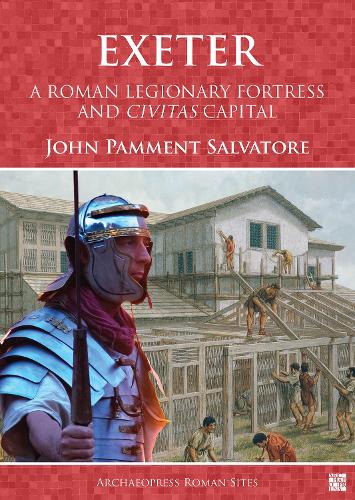

Exeter: A Roman Legionary Fortress and Civitas Capital
Couldn't load pickup availability
Collapsible content
DESCRIPTION
This accessible summary of the archaeological evidence from Roman Exeter reveals its origins as a legionary fortress garrisoned by the Second Augustan Legion. After the legion departed to Wales, Exeter became a Roman regional capital and continued to flourish on the very western edge of the Empire before its ultimate demise in the late 4th century. Exeter has long been known as a Roman city, but it was only in 1971 that its origin as a legionary fortress of the mid-first century AD was revealed. That discovery was the result of excavation work undertaken by the first professional archaeological unit to be based in the city. The author was one of those involved and this book explains how innovative archaeological techniques introduced in the 1970s were employed, not only to construct a picture of the legionary fortress, but to demonstrate with some confidence that the 5,000 strong garrison which manned it was the Second Augustan Legion. Whilst at Exeter the legion built its own stone bathhouse. Constructed only around 15-20 years after the Roman invasion in AD 43, it is the earliest known monumental masonry building in the South-West of Britain. Significantly, it was also possible to establish that Exeter became a Roman regional capital around AD 80 after the departure of the legion to Wales. The redundant bathhouse was converted to a basilica (council chamber and administrative centre) for the fledgling city which went on to acquire a circuit of walls by the start of the third century. Exeter continued to flourish as a Roman city on the very western edge of the Roman Empire before its ultimate demise in the late fourth century.
DELIVERY & RETURNS
UK Delivery:
- Free delivery on all orders of £10 or more.
- £1.49 delivery fee on orders below £10.
- UK orders are shipped via Royal Mail 2nd Class.
International Delivery:
- Flat rate delivery charges vary by country.
Dispatch and Delivery Times:
- All orders are shipped from our warehouse in Northampton, UK within 48 hours of receipt during working hours.
- UK mainland orders typically arrive within 3-5 working days via Royal Mail 2nd Class.
- International estimated delivery times:
- Europe & Channel Islands: 7 to 10 working days
- USA: 7 to 15 working days
- Rest of the World: 9 to 21 working days
View our full delivery infomation here.
-
OVER
2 MILLION PRODUCTS
-
60 MILLION CUSTOMERS
ACROSS 190 COUNTRIES
You might also like
Loading recommendations...