

Historicizing the Enlightenment (2 Vol Set)
Historicizing the Enlightenment (2 Vol Set)
Paperback
Couldn't load pickup availability
Join our rewards scheme and earn reward points on this purchase!
Earn points on this!
Sign in or Sign up!- Release Date: 14/07/2023
- Barcode: 9781684484850
- Genre: Non-Fiction
- Sub-Genre: History
- Imprint: Rutgers University Press
- Publisher: Rutgers University Press
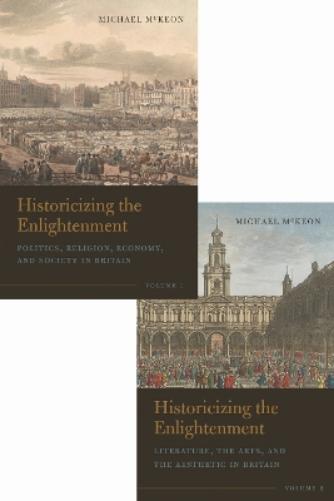

Historicizing the Enlightenment (2 Vol Set)
Couldn't load pickup availability
Collapsible content
DESCRIPTION
This book “historicizes” the British Enlightenment, 1650-1800, as the beginning of the modern world by reconstructing what it was like to live through the emergence of concepts and practices that have come to define the character of daily existence.
The Enlightenment has been blamed for some of the most deadly developments of modern life: racism and white supremacy, imperialist oppression, capitalist exploitation, neoliberal economics, scientific positivism, totalitarian rule. These developments are thought to have grown from principles that are rooted in the soil of the Enlightenment: abstraction, reduction, objectification, quantification, division, universalization. Michael McKeon’s collection corrects this defective view by historicizing the Enlightenment--by showing that the Enlightenment has been abstracted from its history. From its past: critics have ignored that Enlightenment thought is a reaction against deadly traditions that precede it. From its present: the Enlightenment extended its reactive analysis of the past to its own present through self-analysis and self-criticism. From its future: much of what’s been blamed amounts to the failure of its posterity to sustain Enlightenment principles. To historicize the Enlightenment requires that we conjure what it was like to live through the emergence of concepts and practices that are now commonplace-society, privacy, the public, the market, experiment, secularity, representative democracy, human rights, social class, sex and gender, fiction, the aesthetic attitude. McKeon’s collection argues the continuity of Enlightenment thought, its consistency and integrity across this broad range of conceptual domains. It also shows how the Enlightenment has shaped our views of both tradition and modernity, and the revisionary work that needs to be done in order to understand our place in the future. In the process, Historicizing the Enlightenment exemplifies a distinctive historiography and historical method.
DELIVERY & RETURNS
UK Delivery:
- Free delivery on all orders of £10 or more.
- £1.49 delivery fee on orders below £10.
- UK orders are shipped via Royal Mail 2nd Class.
International Delivery:
- Flat rate delivery charges vary by country.
Dispatch and Delivery Times:
- All orders are shipped from our warehouse in Northampton, UK within 48 hours of receipt during working hours.
- UK mainland orders typically arrive within 3-5 working days via Royal Mail 2nd Class.
- International estimated delivery times:
- Europe & Channel Islands: 7 to 10 working days
- USA: 7 to 15 working days
- Rest of the World: 9 to 21 working days
View our full delivery infomation here.
-
OVER
2 MILLION PRODUCTS
-
60 MILLION CUSTOMERS
ACROSS 190 COUNTRIES
You might also like
Loading recommendations...