

Electromagnetic and Photonic Simulation for the Beginner: Finite-Difference Frequency-Domain in MATLAB (R)
Electromagnetic and Photonic Simulation for the Beginner: Finite-Difference Frequency-Domain in MATLAB (R)
Hardback
Couldn't load pickup availability
Join our rewards scheme and earn reward points on this purchase!
Earn points on this!
Sign in or Sign up!- Release Date: 31/01/2022
- Barcode: 9781630819262
- Imprint: Artech House Publishers
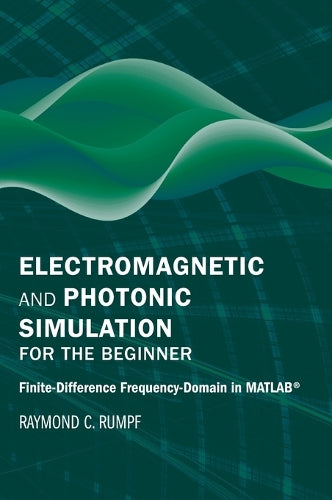

Electromagnetic and Photonic Simulation for the Beginner: Finite-Difference Frequency-Domain in MATLAB (R)
Couldn't load pickup availability
Collapsible content
DESCRIPTION
This book teaches the finite-difference frequency-domain (FDFD) method from the simplest concepts to advanced three-dimensional simulations. It uses plain language and high-quality graphics to help the complete beginner grasp all the concepts quickly and visually. This single resource includes everything needed to simulate a wide variety of different electromagnetic and photonic devices. The book is filled with helpful guidance and computational wisdom that will help the reader easily simulate their own devices and more easily learn and implement other methods in computational electromagnetics. Special techniques in MATLAB (R) are presented that will allow the reader to write their own FDFD programs. Key concepts in electromagnetics are reviewed so the reader can fully understand the calculations happening in FDFD. A powerful method for implementing the finite-difference method is taught that will enable the reader to solve entirely new differential equations and sets of differential equations in mere minutes. Separate chapters are included that describe how Maxwell's equations are approximated using finite-differences and how outgoing waves can be absorbed using a perfectly matched layer absorbing boundary. With this background, a chapter describes how to calculate guided modes in waveguides and transmission lines. The effective index method is taught as way to model many three-dimensional devices in just two-dimensions. Another chapter describes how to calculate photonic band diagrams and isofrequency contours to quickly estimate the properties of periodic structures like photonic crystals. Next, a chapter presents how to analyze diffraction gratings and calculate the power coupled into each diffraction order. This book shows that many devices can be simulated in the context of a diffraction grating including guided-mode resonance filters, photonic crystals, polarizers, metamaterials, frequency selective surfaces, and metasurfaces. Plane wave sources, Gaussian beam sources, and guided-mode sources are all described in detail, allowing devices to be simulated in multiple ways. An optical integrated circuit is simulated using the effective index method to build a two-dimensional model of the 3D device and then launch a guided-mode source into the circuit. A chapter is included to describe how the code can be modified to easily perform parameter sweeps, such as plotting reflection and transmission as a function of frequency, wavelength, angle of incidence, or a dimension of the device. The last chapter is advanced and teaches FDFD for three-dimensional devices composed of anisotropic materials. It includes simulations of a crossed grating, a doubly-periodic guided-mode resonance filter, a frequency selective surface, and an invisibility cloak. The chapter also includes a parameter retrieval from a left-handed metamaterial. The book includes all the MATLAB codes and detailed explanations of all programs. This will allow the reader to easily modify the codes to simulate their own ideas and devices. The author has created a website where the MATLAB codes can be downloaded, errata can be seen, and other learning resources can be accessed. This is an ideal book for both an undergraduate elective course as well as a graduate course in computational electromagnetics because it covers the background material so well and includes examples of many different types of devices that will be of interest to a very wide audience. Visit https://empossible.net/fdfdbook/ to access the book website.Visit https://raymondrumpf.com/ for Raymond C. Rumpf's personal webpage.
ADDITIONAL DETAILS
DELIVERY & RETURNS
UK Delivery:
- Free delivery on all orders of £10 or more.
- £1.49 delivery fee on orders below £10.
- UK orders are shipped via Royal Mail 2nd Class.
International Delivery:
- Flat rate delivery charges vary by country.
Dispatch and Delivery Times:
- All orders are shipped from our warehouse in Northampton, UK as soon as stock is available.
- UK mainland orders typically arrive within 3-7 working days via Royal Mail 2nd Class.
- International estimated delivery times:
- Europe & Channel Islands: 7 to 10 working days
- USA: 7 to 15 working days
- Rest of the World: 9 to 30 working days
View our full delivery infomation here.
-
OVER
2 MILLION PRODUCTS
-
60 MILLION CUSTOMERS
ACROSS 190 COUNTRIES
You might also like
Loading recommendations...