

Business Dynamics Models
Business Dynamics Models
Optimization-Based One Step Ahead Optimal Control
Paperback
Couldn't load pickup availability
Join our rewards scheme and earn reward points on this purchase!
Earn points on this!
Sign in or Sign up!- Release Date: 30/11/2022
- Barcode: 9781611977301
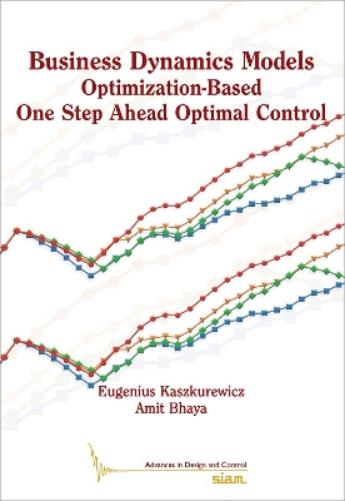

Business Dynamics Models
Couldn't load pickup availability
Collapsible content
DESCRIPTION
Optimization-Based One Step Ahead Optimal Control
Introduces optimal control methods, formulated as optimization problems, applied to business dynamics problems. The book includes solutions that provide a rationale for the use of optimal control and guidelines for further investigation into more complex models.
This book introduces optimal control methods, formulated as optimization problems, applied to business dynamics problems. Business dynamics refers to a combination of business management and financial objectives embedded in a dynamical system model. The model is subject to a control that optimizes a performance index and takes both management and financial aspects into account.
Business Dynamics Models: Optimization-Based One Step Ahead Optimal Control includes solutions that provide a rationale for the use of optimal control and guidelines for further investigation into more complex models, as well as formulations that can also be used in a so-called flight simulator mode to investigate different complex scenarios. The text offers a modern programming environment (Jupyter notebooks in JuMP/Julia) for modeling, simulation, and optimization, and Julia code and notebooks are provided on a website for readers to experiment with their own examples.
This book is intended for students majoring in applied mathematics, business, and engineering. The authors use a formulation-algorithm-example approach, rather than the classical definition-theorem-proof, making the material understandable to senior undergraduates and beginning graduates.
DELIVERY & RETURNS
UK Delivery:
- Free delivery on all orders of £10 or more.
- £1.49 delivery fee on orders below £10.
- UK orders are shipped via Royal Mail 2nd Class.
International Delivery:
- Flat rate delivery charges vary by country.
Dispatch and Delivery Times:
- All orders are shipped from our warehouse in Northampton, UK within 48 hours of receipt during working hours.
- UK mainland orders typically arrive within 3-5 working days via Royal Mail 2nd Class.
- International estimated delivery times:
- Europe & Channel Islands: 7 to 10 working days
- USA: 7 to 15 working days
- Rest of the World: 9 to 21 working days
View our full delivery infomation here.
-
OVER
2 MILLION PRODUCTS
-
60 MILLION CUSTOMERS
ACROSS 190 COUNTRIES
You might also like
Loading recommendations...