

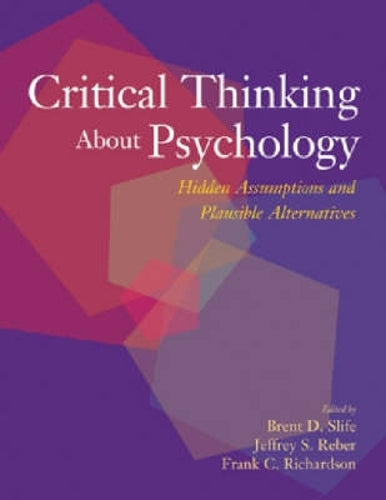
Critical Thinking About Psychology
Critical Thinking About Psychology
Hidden Assumptions and Plausible Alternatives
Hardback
Couldn't load pickup availability
Join our rewards scheme and earn reward points on this purchase!
Earn points on this!
Sign in or Sign up!- Release Date: 15/12/2004
- Barcode: 9781591471875
- Genre: Society & Culture
- Sub-Genre: Psychology
- Imprint: American Psychological Association
- Publisher: American Psychological Association

Critical Thinking About Psychology
Couldn't load pickup availability
Collapsible content
DESCRIPTION
Hidden Assumptions and Plausible Alternatives
Contributors challenge established conventions in psychology by deconstructing widely held beliefs and offering alternative perspectives across diverse subfields. They scrutinize dualistic mind–body models and the notion of a discrete individual, inviting deeper reflection on human development and scientific inquiry.
In Critical Thinking About Psychology: Hidden Assumptions and Plausible Alternatives contributors examine the unquestioned givens of psychology and suggest other ways of looking at them. Psychologists are taught early in their careers to use their research findings to examine common myths and debunk false beliefs. Yet, in spite of this emphasis on critical analysis, psychologists do not typically subject psychology itself to such evaluation. In this fascinating volume, experts from varied subdisciplines critique assumptions peculiar to their specialty and then propose alternatives to replace the original assumptions.
The book covers six major psychology subdisciplines, ranging from clinical psychology to neuropsychology. Contributors critique unquestioned tenets of the field such as the dualism between mind and body, the truth of efficient causation, and the discrete unit known as the individual. Authors then provide alternative ways of seeing the field, such as nondualistic models of the self and a moral vision of human development, effectively creating new conceptual ground for psychology.
In analyzing what is taken for granted, this volume teaches critical thinking skills at the same time that it moves psychology in exciting new directions.
ADDITIONAL DETAILS
DELIVERY & RETURNS
UK Delivery:
- Free delivery on all orders of £10 or more.
- £1.49 delivery fee on orders below £10.
- UK orders are shipped via Royal Mail 2nd Class.
International Delivery:
- Flat rate delivery charges vary by country.
Dispatch and Delivery Times:
- All orders are shipped from our warehouse in Northampton, UK within 48 hours of receipt during working hours.
- UK mainland orders typically arrive within 3-5 working days via Royal Mail 2nd Class.
- International estimated delivery times:
- Europe & Channel Islands: 7 to 10 working days
- USA: 7 to 15 working days
- Rest of the World: 9 to 21 working days
View our full delivery infomation here.
-
OVER
2 MILLION PRODUCTS
-
60 MILLION CUSTOMERS
ACROSS 190 COUNTRIES
You might also like
Loading recommendations...