

Circular Textile Economy
Circular Textile Economy
Hardback
Couldn't load pickup availability
Join our rewards scheme and earn reward points on this purchase!
Earn points on this!
Sign in or Sign up!- Release Date: 12/12/2025
- Barcode: 9781569902301
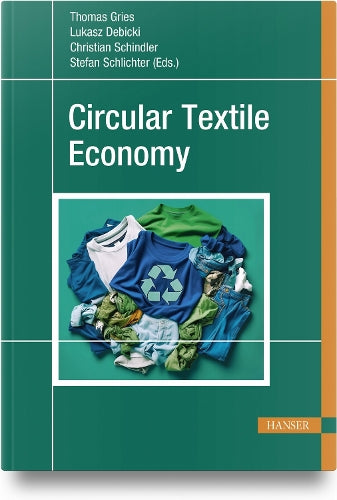

Circular Textile Economy
Couldn't load pickup availability
Collapsible content
DESCRIPTION
Discover textile-to-textile recycling strategies that drive circular economy transformation by uniting political aims with industrial innovation. Unveiling fundamental principles and actionable industry examples, this narrative outlines pathways to reduce environmental harm and revitalize textile production.
In this book, the concept of the circular economy is examined from the point of view of textile-to-textile recycling, with strong consideration of the latest political objectives. Readers will gain an understanding of the basic principles and implementation possibilities, and discover which textile-to-textile recycling solutions have already been implemented in industry and which solutions are promising for the future. Thus, this work is the starting point for readers who want or need to contribute to saving our environment through concrete actions. The process chain of textile production and recycling is first presented. Based on this, concepts for textile-to-textile recycling are explained and deepened using industry examples. These concepts are further developed and finally implemented as strategies for a transformation into a circular economy. Global fiber production is growing continuously and with it its negative impact on our environment. Although the share of recycled fibers is also increasing, it is mainly linear bottle recycling; the share of pre- or post-consumer textile recycling remains less than 1% of the fiber market. With and international authorship from both industry and academia, and reader-friendly presentation including many illustrations and in-depth practical examples, this book identifies possible solutions to these challenges.
ADDITIONAL DETAILS
DELIVERY & RETURNS
UK Delivery:
- Free delivery on all orders of £10 or more.
- £1.49 delivery fee on orders below £10.
- UK orders are shipped via Royal Mail 2nd Class.
International Delivery:
- Flat rate delivery charges vary by country.
Dispatch and Delivery Times:
- All orders are shipped from our warehouse in Northampton, UK within 48 hours of receipt during working hours.
- UK mainland orders typically arrive within 3-5 working days via Royal Mail 2nd Class.
- International estimated delivery times:
- Europe & Channel Islands: 7 to 10 working days
- USA: 7 to 15 working days
- Rest of the World: 9 to 21 working days
View our full delivery infomation here.
-
OVER
2 MILLION PRODUCTS
-
60 MILLION CUSTOMERS
ACROSS 190 COUNTRIES
You might also like
Loading recommendations...