

Complete Essays: Aldous Huxley, 1926-1930
Complete Essays: Aldous Huxley, 1926-1930
Volume II
Hardback
Couldn't load pickup availability
Join our rewards scheme and earn reward points on this purchase!
Earn points on this!
Sign in or Sign up!- Release Date: 07/11/2000
- Barcode: 9781566633239
- Genre: Poetry & Drama
- Sub-Genre: Literary Criticism
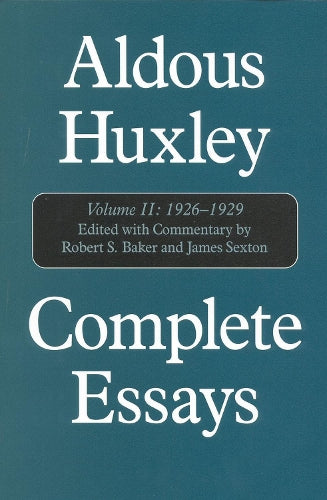

Complete Essays: Aldous Huxley, 1926-1930
Couldn't load pickup availability
Collapsible content
DESCRIPTION
Volume II
These first two volumes of a projected six collect the complete essays of one of the major writers of the 20th century. "His reading was immense, his taste impeccable, and his ear acute.His place in English literature is unique and is certainly assured."—T. S. Eliot. Edited with Commentary by Robert S. Baker and James Sexton.
These first two volumes of a projected five, in preparation for several years, begin a major publishing venture, collecting the complete essays of one of the giants of modern English prose and of social commentary in our time. The first two volumes span the most productive period of Huxley's career. Volume I begins with his essays for Gilbert Murray's Athenaeum and his music essays for the New Westminster Gazette. Volume II continues through the 1920s and includes his controversial essays on India and the empire in "Jesting Pilate." The essays of both volumes range from nuanced assessments of art and architecture to political analyses, history, science, religion, and art, and a newly discovered series on music. Wide-ranging, allusive, and witty, they are informed by the probing skepticism of a highly educated and ironically incisive member of the English upper middle class. Huxley's fascination with the codes and conventions of European culture, his growing apprehensions about the menacing collapse of the European political order, and his awareness of the impact of science and technology on the post-Versailles world of England, France, Germany, and the United States form the basis for his critique. His subjects overlap with the satirical novels he wrote during the period between the wars, culminating in Point Counter Point and Brave New World. At their best, these essays stand among the finest examples of the genre in modern literature.
ADDITIONAL DETAILS
DELIVERY & RETURNS
UK Delivery:
- Free delivery on all orders of £10 or more.
- £1.49 delivery fee on orders below £10.
- UK orders are shipped via Royal Mail 2nd Class.
International Delivery:
- Flat rate delivery charges vary by country.
Dispatch and Delivery Times:
- All orders are shipped from our warehouse in Northampton, UK within 48 hours of receipt during working hours.
- UK mainland orders typically arrive within 3-5 working days via Royal Mail 2nd Class.
- International estimated delivery times:
- Europe & Channel Islands: 7 to 10 working days
- USA: 7 to 15 working days
- Rest of the World: 9 to 21 working days
View our full delivery infomation here.
-
OVER
2 MILLION PRODUCTS
-
60 MILLION CUSTOMERS
ACROSS 190 COUNTRIES
You might also like
Loading recommendations...