

The Public Realm and the Public Self
The Public Realm and the Public Self
Paperback
Couldn't load pickup availability
Join our rewards scheme and earn reward points on this purchase!
Earn points on this!
Sign in or Sign up!- Release Date: 30/10/2008
- Barcode: 9781554581528
- Genre: Law & Politics
- Subgenre: Philosophy & Spirituality

The Public Realm and the Public Self
Couldn't load pickup availability
Collapsible content
DESCRIPTION
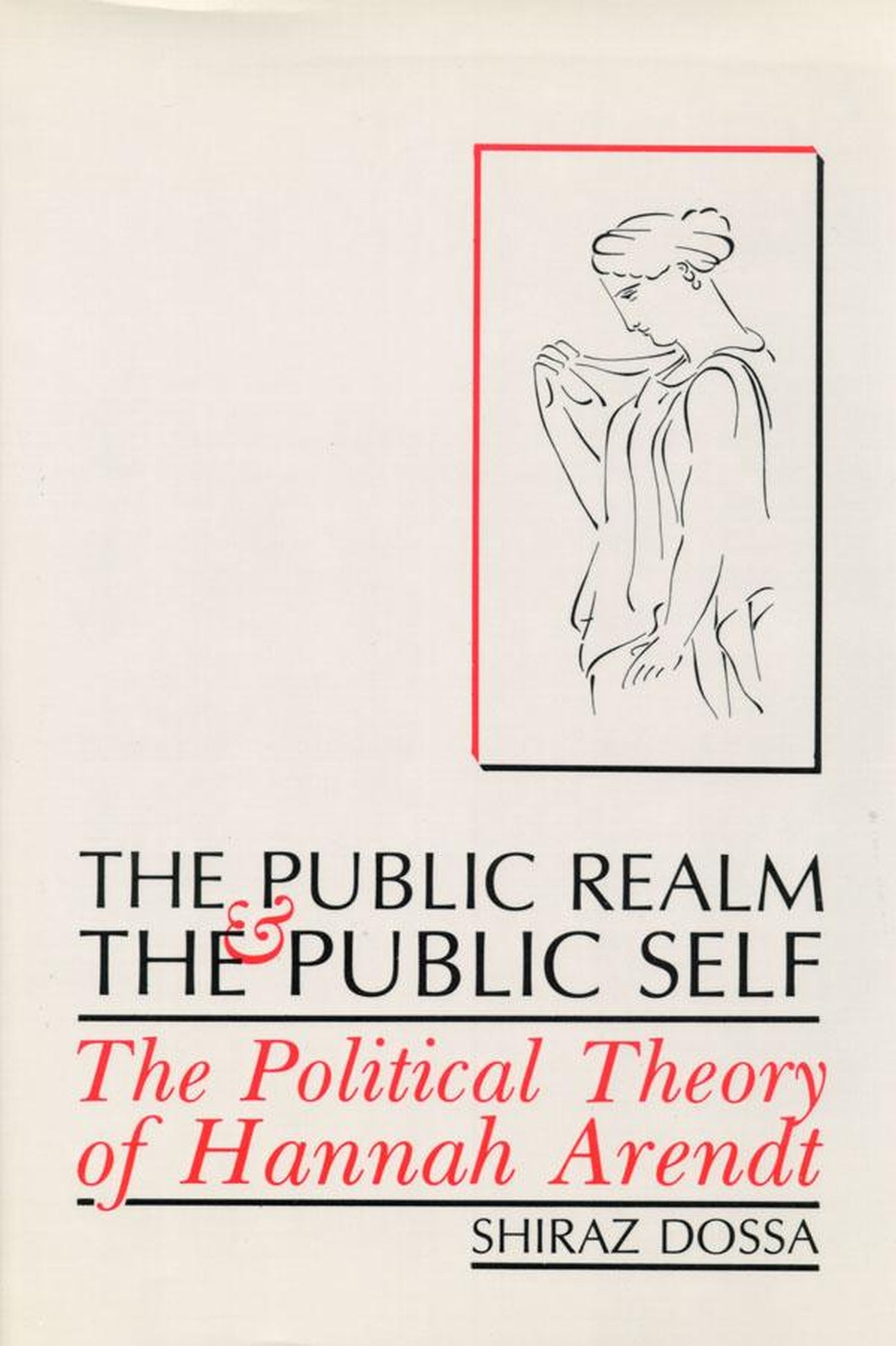
The Political Theory of Hannah Arendt From the time she set the intellectual world on fire with her reflections on Eichmann (1963), Hannah Arendt has been seen, essentially, as a literary commentator who had interesting things to say about political and cultural matters. In this critical study, Shiraz Dossa argues that Arendt is a political theorist in the sense in which Aristotle is a theorist, and that the key to her political theory lies in the twin notions of the ""public realm"" and the ""public self"". In this work, the author explains how Arendt's unconventional and controversial views make sense on the terrain of her political theory. He shows that her judgement on thinkers, actors, and events as diverse as Plato, Marx, Machiavelli, Freud, Conrad, Hobbes, Hitler, the Holocaust, the French Revolution, and European colonialism flow directly from her political theory. Tracing the origins of this theory to Homer and Periclean Athens, Dossa underlines Arendt's unique contribution to reinventing the idea and the ideal of citizenship, reminding us that the public realm is the locus of friendship, community, identity, and in a certain sense, humanity. Arendt believes that no one who prefets his or her private interest to public affairs in the old sense can claim to be fully human or truly excellent.
Hannah Arendt has been seen as a literary commentator who had interesting things to say about political and cultural matters. This study argues that Arendt is a political theorist in the sense in which Aristotle is a theorist, and that the key to her political theory lies in the twin notions of the 'public realm' and the 'public self'.
DELIVERY & RETURNS
UK Delivery:
- Free delivery on all orders of £10 or more.
- £1.49 delivery fee on orders below £10.
- UK orders are shipped via Royal Mail 2nd Class.
International Delivery:
- Flat rate delivery charges vary by country.
Dispatch and Delivery Times:
- All orders are shipped from our warehouse in Northampton, UK as soon as stock is available.
- UK mainland orders typically arrive within 3-7 working days via Royal Mail 2nd Class.
- International estimated delivery times:
- Europe & Channel Islands: 7 to 10 working days
- USA: 7 to 15 working days
- Rest of the World: 9 to 30 working days
View our full delivery infomation here.
-
OVER
2 MILLION PRODUCTS
-
60 MILLION CUSTOMERS
ACROSS 190 COUNTRIES
You might also like
Loading recommendations...