

Characterizations of Recently Introduced Univariate Continuous Distributions II
Characterizations of Recently Introduced Univariate Continuous Distributions II
Hardback
Couldn't load pickup availability
Join our rewards scheme and earn reward points on this purchase!
Earn points on this!
Sign in or Sign up!- Release Date: 17/05/2019
- Barcode: 9781536150957
- Genre: Science Nature & Math
- Imprint Family: Nova Science
- Publisher: Nova Science Publishers
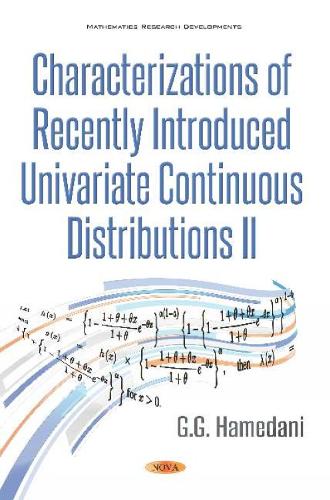

Characterizations of Recently Introduced Univariate Continuous Distributions II
Couldn't load pickup availability
Collapsible content
DESCRIPTION
This monograph is, as far as the author has gathered, the second of its kind (the first one was published by Nova in 2017 with coauthors Hamedani and Maadooliat) which presents various characterizations of a wide variety of continuous distributions. These two monographs could also be used as sources to prevent reinventing and duplicating the already exiting distributions. The current book consists of seven chapters. The first chapter lists cumulative and density functions of two hundred and twenty univariate distributions. Chapter two provides characterizations of these distributions: (i) based on the ration of two truncated moments; (ii) in terms of the hazard function; (iii) in terms of the reverse hazard function; (iv) based on the conditional expectation of certain functions of the random variable. Chapter three includes the characterizations of twenty distributions, which appeared in a published paper (Hamedani and Safavimanesh, 2017). Chapter four presents characterizations of thirty six distributions, contains a published paper (Hamedani, 2017). Chapter five covers the characterizations of forty one distributions, which appeared in a published paper (Hamedani, 2018a). Chapter six presents characterizations of eighty distributions, contained in a published paper (Hamedani, 2018b). Finally, chapter seven consists of seventy proposed distributions. The main reason to include previously published papers in Chapters 3-6 is to provide a rather complete source for the interested researchers who would want to avoid reinventing the existing distributions.
DELIVERY & RETURNS
UK Delivery:
- Free delivery on all orders of £10 or more.
- £1.49 delivery fee on orders below £10.
- UK orders are shipped via Royal Mail 2nd Class.
International Delivery:
- Flat rate delivery charges vary by country.
Dispatch and Delivery Times:
- All orders are shipped from our warehouse in Northampton, UK within 48 hours of receipt during working hours.
- UK mainland orders typically arrive within 3-5 working days via Royal Mail 2nd Class.
- International estimated delivery times:
- Europe & Channel Islands: 7 to 10 working days
- USA: 7 to 15 working days
- Rest of the World: 9 to 21 working days
View our full delivery infomation here.
-
OVER
2 MILLION PRODUCTS
-
60 MILLION CUSTOMERS
ACROSS 190 COUNTRIES
You might also like
Loading recommendations...