

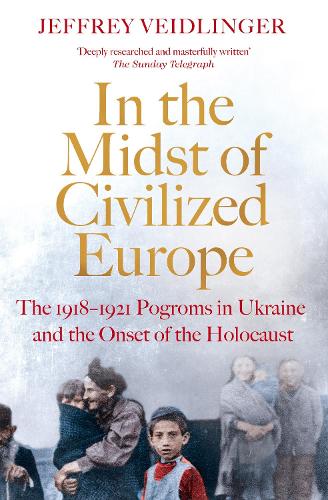
In the Midst of Civilized Europe
In the Midst of Civilized Europe
The 1918–1921 Pogroms in Ukraine and the Onset of the Holocaust
Paperback
Couldn't load pickup availability
Join our rewards scheme and earn reward points on this purchase!
Earn points on this!
Sign in or Sign up!- Release Date: 03/11/2022
- Barcode: 9781509867479
- Genre: Non-Fiction
- Sub-Genre: History
- Imprint: Picador
- Publisher: Pan Macmillan

In the Midst of Civilized Europe
Couldn't load pickup availability
Collapsible content
DESCRIPTION
The 1918–1921 Pogroms in Ukraine and the Onset of the Holocaust A Times Literary Supplement Book of the Year
In the Midst of Civilized Europe is an extensively researched account of a forgotten history.
A riveting account of a forgotten holocaust: the slaughter of over one hundred thousand Ukrainian Jews in the aftermath of the Russian Revolution. In the Midst of Civilized Europe repositions the pogroms as a defining moment of the twentieth century.
‘Exhaustive, clearly written, deeply researched’ - The Times
‘A meticulous, original and deeply affecting historical account’ - Philippe Sands, author of East West Street
Between 1918 and 1921, over a hundred thousand Jews were murdered in Ukraine by peasants, townsmen, and soldiers who blamed the Jews for the turmoil of the Russian Revolution. In hundreds of separate incidents, ordinary people robbed their Jewish neighbours with impunity, burned down their houses, ripped apart their Torah scrolls, sexually assaulted them, and killed them. Largely forgotten today, these pogroms – ethnic riots – dominated headlines and international affairs in their time. Aid workers warned that six million Jews were in danger of complete extermination. Twenty years later, these dire predictions would come true.
Drawing upon long-neglected archival materials, including thousands of newly discovered witness testimonies, trial records, and official orders, acclaimed historian Jeffrey Veidlinger shows for the first time how this wave of genocidal violence created the conditions for the Holocaust. Through stories of survivors, perpetrators, aid workers, and governmental officials, he explains how so many different groups of people came to the same conclusion: that killing Jews was an acceptable response to their various problems.
DELIVERY & RETURNS
UK Delivery:
- Free delivery on all orders of £10 or more.
- £1.49 delivery fee on orders below £10.
- UK orders are shipped via Royal Mail 2nd Class.
International Delivery:
- Flat rate delivery charges vary by country.
Dispatch and Delivery Times:
- All orders are shipped from our warehouse in Northampton, UK within 48 hours of receipt during working hours.
- UK mainland orders typically arrive within 3-5 working days via Royal Mail 2nd Class.
- International estimated delivery times:
- Europe & Channel Islands: 7 to 10 working days
- USA: 7 to 15 working days
- Rest of the World: 9 to 21 working days
View our full delivery infomation here.
-
OVER
2 MILLION PRODUCTS
-
60 MILLION CUSTOMERS
ACROSS 190 COUNTRIES
You might also like
Loading recommendations...