

Regimes of Mobility
Regimes of Mobility
Borders and State Formation in the Middle East, 1918-1946
Paperback
Couldn't load pickup availability
Join our rewards scheme and earn reward points on this purchase!
Earn points on this!
Sign in or Sign up!- Release Date: 15/11/2023
- Barcode: 9781474487979
- Genre: Society & Culture
- Sub-Genre: Politics & Government
- Imprint: Edinburgh University Press
- Publisher: Edinburgh University Press
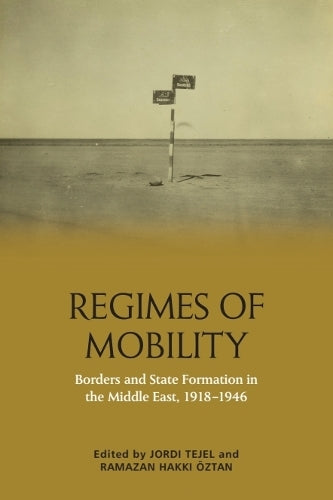

Regimes of Mobility
Couldn't load pickup availability
Collapsible content
DESCRIPTION
Borders and State Formation in the Middle East, 1918-1946
Reinterprets the making of the modern Middle East by studying its borderlands, drawing on case studies of Turkey, Iraq, Syria, Palestine and Transjordan to overturn popular views of how the borders of the region were formed.
Reinterprets the making of the modern Middle East by studying its borderlands Evidence-driven case studies cover borderlands in Turkey, Iraq, Syria, Palestine and Transjordan Informed by discussions in borderland and mobility studies, and by global and environmental history Brings late Ottomanists into conversation with historians of the interwar Middle East For the past two decades, insights gained from the burgeoning field of borderlands studies have enabled a new generation of scholars to challenge popular depictions of the emergence of the modern Middle East. For them, the region's borderlands were not just mere sites of peripheral activity, but rather liminal spaces criss-crossed by global flows and circulations central to state- and nation-formation across the Middle East. Regimes of Mobility offers a select number of case studies that highlight the connectedness of the politics of borderlands throughout the interwar Middle East. The emergence of the modern Middle East is the result of three complementary historical developments: the disintegration of the Ottoman Empire, the institution of British and French control in its stead and the nationalist challenges to this colonial scramble. The introduction of international borders that accompanied this process is commonly portrayed as the drawing of lines in the sand, an artificial partitioning that brought diplomatic closure to an otherwise contested historical space.
ADDITIONAL DETAILS
DELIVERY & RETURNS
UK Delivery:
- Free delivery on all orders of £10 or more.
- £1.49 delivery fee on orders below £10.
- UK orders are shipped via Royal Mail 2nd Class.
International Delivery:
- Flat rate delivery charges vary by country.
Dispatch and Delivery Times:
- All orders are shipped from our warehouse in Northampton, UK within 48 hours of receipt during working hours.
- UK mainland orders typically arrive within 3-5 working days via Royal Mail 2nd Class.
- International estimated delivery times:
- Europe & Channel Islands: 7 to 10 working days
- USA: 7 to 15 working days
- Rest of the World: 9 to 21 working days
View our full delivery infomation here.
-
OVER
2 MILLION PRODUCTS
-
60 MILLION CUSTOMERS
ACROSS 190 COUNTRIES
You might also like
Loading recommendations...