

Statistical Science in the Courtroom
Statistical Science in the Courtroom
Paperback
Couldn't load pickup availability
Join our rewards scheme and earn reward points on this purchase!
Earn points on this!
Sign in or Sign up!- Release Date: 23/10/2012
- Barcode: 9781461270461
- Edition: Softcover reprint of the original 1st ed. 2000
- Genre: Society & Culture
- Subgenre: Social Sciences
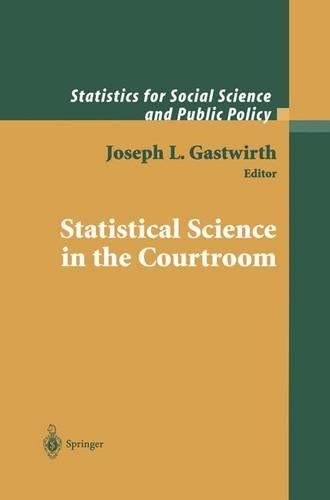

Statistical Science in the Courtroom
Softcover reprint of the original 1st ed. 2000
Couldn't load pickup availability
Collapsible content
DESCRIPTION
Other articles describe the role of statistical evidence in cases concerning discrimination against minorities, product liability, environmental regulation, the appropriateness and fairness of sentences and how being involved in legal statistics has raised interesting statistical problems requiring further research.
Expert testimony relying on scientific and other specialized evidence has come under increased scrutiny by the legal system. A trilogy of recent U.S. Supreme Court cases has assigned judges the task of assessing the relevance and reliability of proposed expert testimony. In conjunction with the Federal judiciary, the American Association for the Advancement of Science has initiated a project to provide judges indicating a need with their own expert. This concern with the proper interpretation of scientific evidence, especially that of a probabilistic nature, has also occurred in England, Australia and in several European countries. Statistical Science in the Courtroom is a collection of articles written by statisticians and legal scholars who have been concerned with problems arising in the use of statistical evidence. A number of articles describe DNA evidence and the difficulties of properly calculating the probability that a random individual's profile would "match" that of the evidence as well as the proper way to intrepret the result. In addition to the technical issues, several authors tell about their experiences in court. A few have become disenchanted with their involvement and describe the events that led them to devote less time to this application. Other articles describe the role of statistical evidence in cases concerning discrimination against minorities, product liability, environmental regulation, the appropriateness and fairness of sentences and how being involved in legal statistics has raised interesting statistical problems requiring further research.
DELIVERY & RETURNS
UK Delivery:
- Free delivery on all orders of £10 or more.
- £1.49 delivery fee on orders below £10.
- UK orders are shipped via Royal Mail 2nd Class.
International Delivery:
- Flat rate delivery charges vary by country.
Dispatch and Delivery Times:
- All orders are shipped from our warehouse in Northampton, UK within 48 hours of receipt during working hours.
- UK mainland orders typically arrive within 3-5 working days via Royal Mail 2nd Class.
- International estimated delivery times:
- Europe & Channel Islands: 7 to 10 working days
- USA: 7 to 15 working days
- Rest of the World: 9 to 21 working days
View our full delivery infomation here.
-
OVER
2 MILLION PRODUCTS
-
60 MILLION CUSTOMERS
ACROSS 190 COUNTRIES
You might also like
Loading recommendations...