

Modifying Your Thinking Classroom for Different Settings
Modifying Your Thinking Classroom for Different Settings
A Supplement to Building Thinking Classrooms in Mathematics
Paperback
Couldn't load pickup availability
Join our rewards scheme and earn reward points on this purchase!
Earn points on this!
Sign in or Sign up!- Release Date: 08/11/2021
- Barcode: 9781071857847
- Publisher: Sage Publications
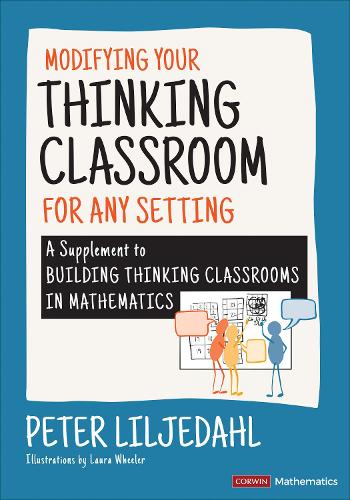

Modifying Your Thinking Classroom for Different Settings
Couldn't load pickup availability
Collapsible content
DESCRIPTION
A Supplement to Building Thinking Classrooms in Mathematics Keep thinking…keep learning in different settings
In Peter Liljedahl’s bestselling Building Thinking Classrooms in Mathematics: 14 Teaching Practices for Enhancing Learning, readers discovered that thinking is a precursor to learning. Translating 15 years of research, the anchor book introduced 14 practices that have the most potential to increase student thinking in the classroom and can work for any teacher in any setting.
But how do these practices work in a classroom with social distancing or in settings that are not always face-to-face? This follow-up supplement will answer those questions, and more. It walks teachers through how to adapt the 14 practices for 12 distinct settings, some of which came about as a result of the COVID-19 pandemic. This guide:
This supplement allows teachers to dip in as needed and continually modify the practices as their own classroom situations change and evolve, always keeping the thinking at the forefront of their mathematics teaching and learning.
DELIVERY & RETURNS
UK Delivery:
- Free delivery on all orders of £10 or more.
- £1.49 delivery fee on orders below £10.
- UK orders are shipped via Royal Mail 2nd Class.
International Delivery:
- Flat rate delivery charges vary by country.
Dispatch and Delivery Times:
- All orders are shipped from our warehouse in Northampton, UK as soon as stock is available.
- UK mainland orders typically arrive within 3-7 working days via Royal Mail 2nd Class.
- International estimated delivery times:
- Europe & Channel Islands: 7 to 10 working days
- USA: 7 to 15 working days
- Rest of the World: 9 to 30 working days
View our full delivery infomation here.
-
OVER
2 MILLION PRODUCTS
-
60 MILLION CUSTOMERS
ACROSS 190 COUNTRIES
You might also like
Loading recommendations...