

Analysis of Threat Perceptions
Analysis of Threat Perceptions
NATO and Türkiye’s Cyber Terrorism Policies
Paperback
Couldn't load pickup availability
Join our rewards scheme and earn reward points on this purchase!
Earn points on this!
Sign in or Sign up!- Release Date: 10/08/2025
- Barcode: 9781032804422
- Imprint: CRC Press
- Publisher: Taylor & Francis
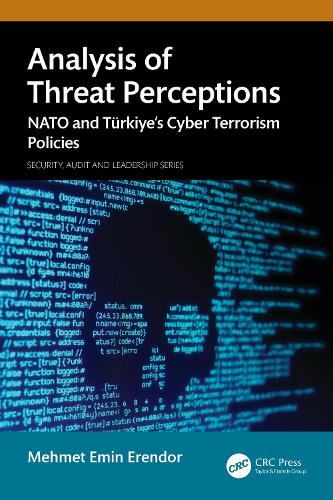

Analysis of Threat Perceptions
Couldn't load pickup availability
Collapsible content
DESCRIPTION
NATO and Türkiye’s Cyber Terrorism Policies The main purpose of this book is to analyze and evaluate what has been carried out regarding NATO’s operational arrangements and its Cyber Defense approach, and, secondly, to explain this in the lens of Game Theory. In 2007, Estonia faced a series of cyberattacks on its cyber infrastructure, which caused widespread damage to the country’s economy, politics, and security. However, despite this series of cyberattacks, the North Atlantic Treaty Organization (NATO) did not apply Article 5 of the North Atlantic Treaty due to lack of consensus on applying Article 5 in the Estonian case. Although various approaches have been developed by scholars, there is no common application of international law in the United Nations Charter regarding cyber threats or attacks. Moreover, while there has been no common definition of "cyber terrorism" by the international community, some scholars regard "cyberattacks" as acts of war. There is a paucity of literature dealing with the application of international law on cyber threats. A new Strategic Concept was adopted in 2010. Its most important development was to identify the significance of cyber threats to all NATO member bodies. When updating its own technology, the organization needs to be ready to defend itself against all kinds of asymmetrical warfare, whether from within or beyond its operational range. However, the terms of Article 5 of the North Atlantic Treaty were imprecise as to whether cyberattacks can be regarded as a form of threat; for this reason, NATO accepted the case‑by‑case concept on cyber threats/attacks in terms of the application of Article 5 by the Wales Summit in 2014. Despite the fact that the Charter of the United Nations has not been revised, if its articles are broadly evaluated, cyberattacks would be accepted as a threat or use of force against the territorial integrity of a state. The main purpose of this book is to analyze and evaluate what has been carried out regarding NATO’s operational arrangements and its cyber defense approach and, secondly, to explain this through the lens of Game Theory. Furthermore, it will demonstrate why the web is paramount to NATO’s system‑driven operations, and why it requires a cyber defense arrangement. In particular, the research presented here will analyze Türkiye in this regard. The cyberattack on Estonia in 2007 will be used by way of a case study to explain the development of threat perceptions, risks, international law, cybersecurity policies and application of Game Theory.
DELIVERY & RETURNS
UK Delivery:
- Free delivery on all orders of £10 or more.
- £1.49 delivery fee on orders below £10.
- UK orders are shipped via Royal Mail 2nd Class.
International Delivery:
- Flat rate delivery charges vary by country.
Dispatch and Delivery Times:
- All orders are shipped from our warehouse in Northampton, UK within 48 hours of receipt during working hours.
- UK mainland orders typically arrive within 3-5 working days via Royal Mail 2nd Class.
- International estimated delivery times:
- Europe & Channel Islands: 7 to 10 working days
- USA: 7 to 15 working days
- Rest of the World: 9 to 21 working days
View our full delivery infomation here.
-
OVER
2 MILLION PRODUCTS
-
60 MILLION CUSTOMERS
ACROSS 190 COUNTRIES
You might also like
Loading recommendations...