

East Central Europe since 1989
East Central Europe since 1989
Politics, Culture, and Society
Paperback
Couldn't load pickup availability
Join our rewards scheme and earn reward points on this purchase!
Earn points on this!
Sign in or Sign up!- Release Date: 12/12/2024
- Barcode: 9781032319209
- Imprint: Routledge
- Publisher: Taylor & Francis
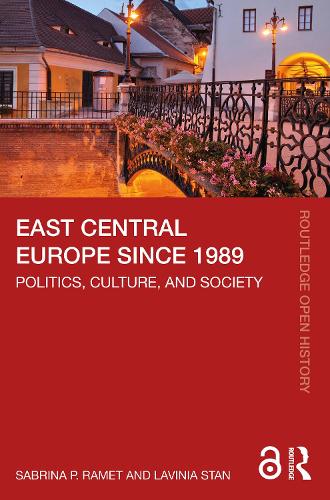

East Central Europe since 1989
Couldn't load pickup availability
Collapsible content
DESCRIPTION
Politics, Culture, and Society This groundbreaking treatment of post-communist developments in East Central Europe examines politics, economics, media, religious institutions, transitional justice, gender inequality, and literature, highlighting the overt functions, latent functions, and side effects associated with each sphere. This groundbreaking treatment of post-communist developments in East Central Europe examines politics, economics, media, religious institutions, transitional justice, gender inequality, and literature, highlighting the overt functions, latent functions, and side effects associated with each sphere. Communism in East Central Europe had cracks from the beginning, as uprisings in East Germany in 1953 and Hungary in 1956 demonstrated. But with the establishment of the Independent Trade Union Solidarity in Poland in the Summer of 1980, communism went into steady decline and, between 1988 and 1991, crumbled. What followed has been an unsteady transition to various forms of often corrupt pluralism with democracy doing best in the Czech Republic (with the exception of the years 2017–2021) and Slovenia, and worst in Hungary, Albania, Serbia, and Bosnia-Herzegovina. Drawing on the functionalist theory of Robert K. Merton, the authors examine what policymakers – communist and post-communist – were or are trying to accomplish, the intended and unintended results of these policies, and the side-effects they have produced. This volume will be of interest not only to specialists in East Central Europe but also to graduate and undergraduate students, members of the diplomatic corps, and general readers.
DELIVERY & RETURNS
UK Delivery:
- Free delivery on all orders of £10 or more.
- £1.49 delivery fee on orders below £10.
- UK orders are shipped via Royal Mail 2nd Class.
International Delivery:
- Flat rate delivery charges vary by country.
Dispatch and Delivery Times:
- All orders are shipped from our warehouse in Northampton, UK as soon as stock is available.
- UK mainland orders typically arrive within 3-7 working days via Royal Mail 2nd Class.
- International estimated delivery times:
- Europe & Channel Islands: 7 to 10 working days
- USA: 7 to 15 working days
- Rest of the World: 9 to 30 working days
View our full delivery infomation here.
-
OVER
2 MILLION PRODUCTS
-
60 MILLION CUSTOMERS
ACROSS 190 COUNTRIES
You might also like
Loading recommendations...