

Affirmative Action for Economically Weaker Sections and Upper-Castes in Indian Constitutional Law
Affirmative Action for Economically Weaker Sections and Upper-Castes in Indian Constitutional Law
Context, Judicial Discourse, and Critique
Paperback
Couldn't load pickup availability
Join our rewards scheme and earn reward points on this purchase!
Earn points on this!
Sign in or Sign up!- Release Date: 27/05/2024
- Barcode: 9781032303581
- Imprint: Routledge
- Publisher: Taylor & Francis
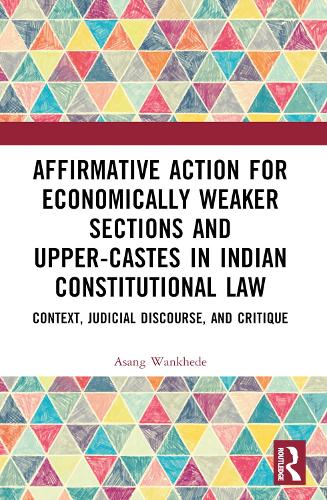

Affirmative Action for Economically Weaker Sections and Upper-Castes in Indian Constitutional Law
Couldn't load pickup availability
Collapsible content
DESCRIPTION
Context, Judicial Discourse, and Critique This book examines the controversial 103rd Constitutional Amendment to the Indian Constitution that introduced an income and asset ownership-based new constitutional standard for determining backwardness marking a significant shift in the government’s social and public policy. This book examines the controversial 103rd Constitutional Amendment to the Indian Constitution that introduced an income and asset ownership-based new constitutional standard for determining backwardness marking a significant shift in the government’s social and public policy. It also analyses state level policies towards backwardness recognition of upper-caste dominant groups through case studies of Maharashtra, Haryana, and Gujarat. It provides an analytical and descriptive account of the proliferation of reservation policy in India and critiques these interventions to assess their implication on constitutional jurisprudence. Further, it assesses the theoretical and empirical challenges such developments pose to the principle of substantive equality and scope of affirmative action policies in Indian constitutional law and general discrimination law theory. The monograph shows how opening up of reservations for dominant upper-caste groups and general category will have implications for the constitutional commitment to addressing deeply entrenched marginalisation emanating from the traditional social hierarchy and the understanding of substantive equality in Indian Constitutional law. Further, it highlights key contradictions, incoherence, and internal tension in the design of the reservations for Economically Weaker Sections Critical, comprehensive, and cogently argued, this book will contribute and shape ongoing constitutional policy and judicial debates. It will be of great interest to scholars and researchers of law, Indian politics, affirmative action, social policy, and public policy.
DELIVERY & RETURNS
UK Delivery:
- Free delivery on all orders of £10 or more.
- £1.49 delivery fee on orders below £10.
- UK orders are shipped via Royal Mail 2nd Class.
International Delivery:
- Flat rate delivery charges vary by country.
Dispatch and Delivery Times:
- All orders are shipped from our warehouse in Northampton, UK within 48 hours of receipt during working hours.
- UK mainland orders typically arrive within 3-5 working days via Royal Mail 2nd Class.
- International estimated delivery times:
- Europe & Channel Islands: 7 to 10 working days
- USA: 7 to 15 working days
- Rest of the World: 9 to 21 working days
View our full delivery infomation here.
-
OVER
2 MILLION PRODUCTS
-
60 MILLION CUSTOMERS
ACROSS 190 COUNTRIES
You might also like
Loading recommendations...