

Contemporary Issues in Quantitative Finance
Contemporary Issues in Quantitative Finance
Paperback
Couldn't load pickup availability
Join our rewards scheme and earn reward points on this purchase!
Earn points on this!
Sign in or Sign up!- Release Date: 10/04/2023
- Barcode: 9781032101125
- Genre: Science Nature & Math
- Subgenre: Business & Finance
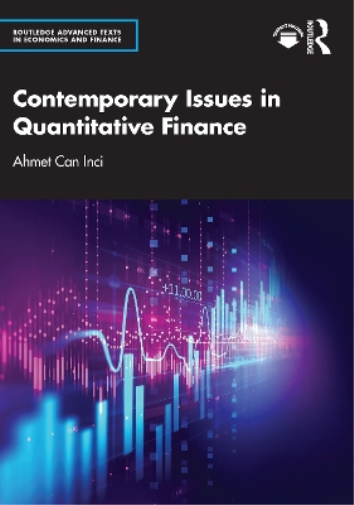

Contemporary Issues in Quantitative Finance
Couldn't load pickup availability
Collapsible content
DESCRIPTION
Contemporary Quantitative Finance connects the abstract theory and the practical use of financial innovations such as ultra-high-frequency trading and cryptocurrencies. It teaches students how to use cutting-edge computational techniques, mathematical tools, and statistical methodologies, with a focus on real-life applications. Contemporary quantitative finance connects the abstract theory and the practical use of financial innovations, such as ultra-high-frequency trading and cryptocurrencies. It teaches students how to use cutting-edge computational techniques, mathematical tools, and statistical methodologies, with a focus on real-life applications. The textbook opens with chapters on financial markets, global finance, and financial crises, setting the subject in its historical and international context. It then examines key topics in modern quantitative finance, including asset pricing, exchange-traded funds, Monte Carlo simulations, options, alternative investments, artificial intelligence, and big data analytics in finance. Complex theory is condensed to intuition, with appendices presenting advanced mathematical or statistical techniques. Each chapter offers Excel-based implementations, conceptual questions, quantitative problems, and a research project, giving students ample opportunity to develop their skills. Clear chapter objectives, summaries, and key terms also support student learning. Digital supplements, including code and PowerPoint slides, are available for instructors. Assuming some prior financial education, this textbook is suited to upper-level undergraduate and postgraduate courses in quantitative finance, financial engineering, and derivatives.
DELIVERY & RETURNS
UK Delivery:
- Free delivery on all orders of £10 or more.
- £1.49 delivery fee on orders below £10.
- UK orders are shipped via Royal Mail 2nd Class.
International Delivery:
- Flat rate delivery charges vary by country.
Dispatch and Delivery Times:
- All orders are shipped from our warehouse in Northampton, UK within 48 hours of receipt during working hours.
- UK mainland orders typically arrive within 3-5 working days via Royal Mail 2nd Class.
- International estimated delivery times:
- Europe & Channel Islands: 7 to 10 working days
- USA: 7 to 15 working days
- Rest of the World: 9 to 21 working days
View our full delivery infomation here.
-
OVER
2 MILLION PRODUCTS
-
60 MILLION CUSTOMERS
ACROSS 190 COUNTRIES
You might also like
Loading recommendations...