

Extending H-Infinity Control to Nonlinear Systems
Extending H-Infinity Control to Nonlinear Systems
Control of Nonlinear Systems to Achieve Performance Objectives
Paperback
Couldn't load pickup availability
Join our rewards scheme and earn reward points on this purchase!
Earn points on this!
Sign in or Sign up!- Release Date: 31/08/1999
- Barcode: 9780898714401
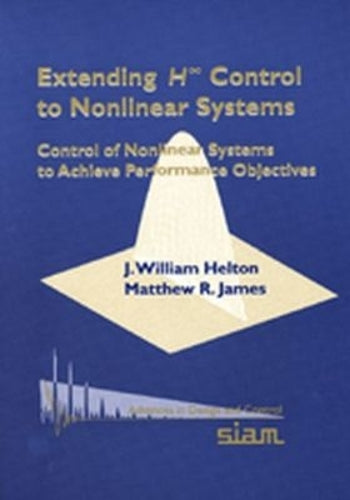

Extending H-Infinity Control to Nonlinear Systems
Couldn't load pickup availability
Collapsible content
DESCRIPTION
Control of Nonlinear Systems to Achieve Performance Objectives
Emphasizes the theory effecting computer solvability of the information state equation, which at the outset looks numerically intractable, but which surprisingly is in many cases tractable. The authors keep the book self-contained by using the appendices to help explain certain prerequisite material.
H-Infinity control originated from an effort to codify classical control methods, where one shapes frequency response functions to meet certain objectives. H-Infinity control underwent tremendous development in the 1980s and made considerable strides toward systematizing classical control. This book addresses the next major issue of how this extends to nonlinear systems.
At the core of nonlinear control theory lie two partial differential equations (PDEs). One is a first-order evolution equation called the information state equation, which constitutes the dynamics of the controller. One can view this equation as a nonlinear dynamical system. Much of this volume is concerned with basic properties of this system, such as the nature of trajectories, stability, and, most important, how it leads to a general solution of the nonlinear H-Infinity control problem.
The second PDE actually builds on a classical type of partial differential inequality (PDI) called a Bellman–Isaacs inequality. While the information state PDE determines the dynamics of the controller, the PDI determines the output of the controller. The authors explore the system theoretic significance of the PDI and present its gross structure. These equations are only a few years old and their study is an expanding area of research.
This book also emphasizes the theory effecting computer solvability of the information state equation, which at the outset looks numerically intractable, but which surprisingly is in many cases tractable. For example, the theory shows that careful initialization has a major influence on computer solvability.
The authors keep the book self-contained by using the appendices to help explain certain prerequisite material. The reader should have a basic knowledge of control theory, real analysis and differential equations, nonlinear operator theory, and nonlinear PDEs.
DELIVERY & RETURNS
UK Delivery:
- Free delivery on all orders of £10 or more.
- £1.49 delivery fee on orders below £10.
- UK orders are shipped via Royal Mail 2nd Class.
International Delivery:
- Flat rate delivery charges vary by country.
Dispatch and Delivery Times:
- All orders are shipped from our warehouse in Northampton, UK within 48 hours of receipt during working hours.
- UK mainland orders typically arrive within 3-5 working days via Royal Mail 2nd Class.
- International estimated delivery times:
- Europe & Channel Islands: 7 to 10 working days
- USA: 7 to 15 working days
- Rest of the World: 9 to 21 working days
View our full delivery infomation here.
-
OVER
2 MILLION PRODUCTS
-
60 MILLION CUSTOMERS
ACROSS 190 COUNTRIES
You might also like
Loading recommendations...