

Akutō and Rural Conflict in Medieval Japan
Akutō and Rural Conflict in Medieval Japan
Paperback
Couldn't load pickup availability
Join our rewards scheme and earn reward points on this purchase!
Earn points on this!
Sign in or Sign up!- Release Date: 28/02/2022
- Barcode: 9780824875350
- Genre: History
- Sub-Genre: Asian History
- Imprint: University of Hawaii Press
- Publisher: University of Hawai'i Press
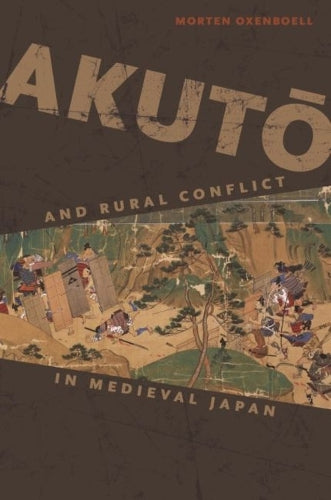

Akutō and Rural Conflict in Medieval Japan
Couldn't load pickup availability
Collapsible content
DESCRIPTION
Offers the first in-depth analysis in English of an understudied phenomenon in medieval Japanese history: the so-called akuto (literally, ‘evil bands’). Morten Oxenboell examines the significance of akuto in legal proceedings to provide a nuanced understanding of how rural communities organized for and engaged in violent conflicts.
This volume offers the first in-depth analysis in English of an understudied phenomenon in medieval Japanese history: the so-called akutō (literally, "evil bands"). Employing chronicles, laws, and legal documents from the thirteenth and fourteenth centuries, as well as recent Japanese scholarship, Morten Oxenboell examines the significance of akutō in legal proceedings to provide a nuanced understanding of how rural communities organized for and engaged in violent conflicts. He deconstructs the image of akutō as instigators of violence by underlining the significance of the term as a rhetorical device used by litigants to voice their grievances in Kamakura legal proceedings. The many instances in which akutō appear offer a clear example of the ways in which the new legal vocabulary concealed realities behind rhetorical flourishes and narratives of violence and predation. Violence was certainly a part of the negotiation for rights and privileges in the estate system, and Oxenboell demonstrates how conflicts developed and were untangled by local actors, who were rarely given a voice in sources from this period. By peeling away the rhetoric, he presents us a unique view of rural populations organizing their communities in the face of violence, whether as victims of outside aggression or as aggressors themselves against landlords or neighbors.
The book therefore goes beyond the usual focus on elites in medieval Japanese history by concentrating on local mobilization schemes and strategies, which were often framed and defamed by central elites. Rural residents, who could not rely on the authorities for protection, handled their own security concerns via complex social mechanisms that tied together locals and absentee landlords in an uneasy relationship of mutual dependency. By examining the fissures in this relationship—in the form of akutō complaints—Oxenboell shows that violent activism was part of the daily management of estates and that such conflicts do not indicate an absence of order but rather a system of checks and balances that helped create a vibrant society.
ADDITIONAL DETAILS
DELIVERY & RETURNS
UK Delivery:
- Free delivery on all orders of £10 or more.
- £1.49 delivery fee on orders below £10.
- UK orders are shipped via Royal Mail 2nd Class.
International Delivery:
- Flat rate delivery charges vary by country.
Dispatch and Delivery Times:
- All orders are shipped from our warehouse in Northampton, UK within 48 hours of receipt during working hours.
- UK mainland orders typically arrive within 3-5 working days via Royal Mail 2nd Class.
- International estimated delivery times:
- Europe & Channel Islands: 7 to 10 working days
- USA: 7 to 15 working days
- Rest of the World: 9 to 21 working days
View our full delivery infomation here.
-
OVER
2 MILLION PRODUCTS
-
60 MILLION CUSTOMERS
ACROSS 190 COUNTRIES
You might also like
Loading recommendations...