

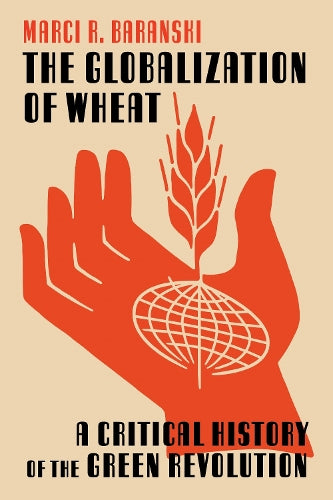
The Globalization of Wheat
The Globalization of Wheat
A Critical History of the Green Revolution
Hardback
Couldn't load pickup availability
Join our rewards scheme and earn reward points on this purchase!
Earn points on this!
Sign in or Sign up!- Release Date: 15/11/2022
- Barcode: 9780822947349
- Genre: Technology & Engineering
- Sub-Genre: Agriculture & Farming
- Imprint: University of Pittsburgh Press
- Publisher: University of Pittsburgh Press

The Globalization of Wheat
Couldn't load pickup availability
Collapsible content
DESCRIPTION
A Critical History of the Green Revolution In The Globalization of Wheat, Marci R. Baranski explores Norman Borlaug’s complicated legacy as godfather of the Green Revolution. Winner of the Nobel Peace Prize in 1970 for his role in fighting global hunger, Borlaug, an American agricultural scientist and plant breeder who worked for the Rockefeller Foundation, left a legacy that divides opinions even today. His high-yielding dwarf wheat varieties, known as miracle seeds, effectively doubled and tripled crop yields across the globe, from Kenya to India and Argentina to Mexico due to their wide adaptation. But these modern seeds also required expensive chemical fertilizers and irrigation, both of which were only available to wealthier farmers. Baranski argues that Borlaug’s new technologies ultimately privileged wealthier farmers, despite assurances to politicians that these new crops would thrive in diverse geographies and benefit all farmers. As large-scale monocultures replaced traditional farming practices, these changes were codified into the Indian wheat research system, thus limiting attention to traditional practices and marginal environments. In the shadow of this legacy, and in the face of accelerating climate change, Baranski brings new light to Borlaug’s role in a controversial concept in agricultural science.
Baranski argues that Borlaug’s new technologies ultimately privileged wealthier farmers, despite assurances to politicians that these new crops would thrive in diverse geographies and benefit all farmers.
ADDITIONAL DETAILS
DELIVERY & RETURNS
UK Delivery:
- Free delivery on all orders of £10 or more.
- £1.49 delivery fee on orders below £10.
- UK orders are shipped via Royal Mail 2nd Class.
International Delivery:
- Flat rate delivery charges vary by country.
Dispatch and Delivery Times:
- All orders are shipped from our warehouse in Northampton, UK as soon as stock is available.
- UK mainland orders typically arrive within 3-7 working days via Royal Mail 2nd Class.
- International estimated delivery times:
- Europe & Channel Islands: 7 to 10 working days
- USA: 7 to 15 working days
- Rest of the World: 9 to 30 working days
View our full delivery infomation here.
-
OVER
2 MILLION PRODUCTS
-
60 MILLION CUSTOMERS
ACROSS 190 COUNTRIES
You might also like
Loading recommendations...