

Was Blind, But Now I See
Was Blind, But Now I See
Hardback
Couldn't load pickup availability
Join our rewards scheme and earn reward points on this purchase!
Earn points on this!
Sign in or Sign up!- Release Date: 01/12/1997
- Barcode: 9780814726433
- Genre: Society & Culture
- Subgenre: Social Sciences
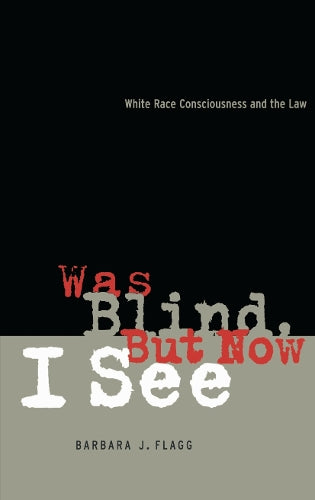

Was Blind, But Now I See
Couldn't load pickup availability
Collapsible content
DESCRIPTION
White Race Concsiousness and the Law Race does not speak to most white people. Rather, whites tend to associate race with people of color and to equate whiteness with racelessness. As Barbara J. Flagg demonstrates in this important book, this "transparency" phenomenon—the invisibility of whiteness to white people—profoundly affects the ways in whites make decisions: they rely on criteria perceived by the decision maker as race-neutral but which in fact reflect white, race-specific norms.
"Race" does not speak to most white people. This title demonstrates "transparency" phenomenon - the invisibility of whiteness to white people - profoundly affects the ways in whites make decisions: they rely on criteria perceived by the decisionmaker as race-neutral but which in fact reflect white, race-specific norms.
Flagg here identifies this transparently white decision making as a form of institutional racism that contributes significantly, though unobtrusively, to the maintenance of white supremacy. Bringing the discussion to bear on the arena of law, Flagg analyzes key areas of race discrimination law and makes the case for reforms that would bring legal doctrine into greater harmony with the recognition of institutional racism in general and the transparency phenomenon in particular. She concludes with an exploration of the meaning of whiteness in a pluralist culture, paving the way for a positive, nonracist conception of whiteness as a distinct racial identity.
An informed and substantive call for doctrinal reform, Was Blind But Now I See is the most expansive treatment yet of the relationship between whiteness and law.
DELIVERY & RETURNS
UK Delivery:
- Free delivery on all orders of £10 or more.
- £1.49 delivery fee on orders below £10.
- UK orders are shipped via Royal Mail 2nd Class.
International Delivery:
- Flat rate delivery charges vary by country.
Dispatch and Delivery Times:
- All orders are shipped from our warehouse in Northampton, UK within 48 hours of receipt during working hours.
- UK mainland orders typically arrive within 3-5 working days via Royal Mail 2nd Class.
- International estimated delivery times:
- Europe & Channel Islands: 7 to 10 working days
- USA: 7 to 15 working days
- Rest of the World: 9 to 21 working days
View our full delivery infomation here.
-
OVER
2 MILLION PRODUCTS
-
60 MILLION CUSTOMERS
ACROSS 190 COUNTRIES
You might also like
Loading recommendations...