

Dynamics of Inequality and Poverty
Dynamics of Inequality and Poverty
Hardback
Couldn't load pickup availability
Join our rewards scheme and earn reward points on this purchase!
Earn points on this!
Sign in or Sign up!- Release Date: 01/07/2006
- Barcode: 9780762313501
- Genre: Business & Finance
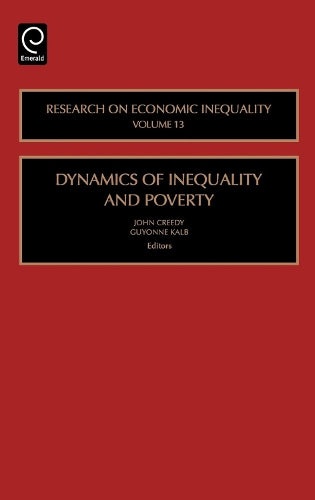

Dynamics of Inequality and Poverty
Couldn't load pickup availability
Collapsible content
DESCRIPTION
Consists of papers related to the theme of the dynamics of inequality and poverty that are subdivided into four separate parts. This volume examines inequality and poverty over time, the intergenerational transfer of poverty, inequality over time, and measurement issues. The chapters discuss inequality and poverty in developed countries.
This volume consists of a number of papers related to the theme of the dynamics of inequality and poverty. These are subdivided into four separate parts. The five chapters in Part I of this volume are concerned with inequality and poverty over extended time periods. Bandyopadhyay and Cowell deal with the concept of vulnerability in the context of income mobility of the poor. Biewen studies the extent and the composition of chronic poverty in Germany, comparing the results with the United Kingdom and the United States. Van de Ven describes a dynamic microsimulation model of cohort labour earnings based on the Australian population aged between 20 and 55 years, and considers how the widening social gap between the Australia and the UK is reflected by their redistributive systems, through the use of static and dynamic microsimulation. Kelly analyses the lifetime distribution of net worth in Australia using a dynamic microsimulation model to project the cross-sectional and lifetime asset holdings of a 5-year birth cohort over a period of 40 years. In Part II, the issue of intergenerational transfers of poverty is considered. Corak compares generational earnings mobility and the reasons for the degree to which the long run labour market success of children is related to that of their parents across countries. He provides a framework for understanding the underlying causal process as well as the conception of equality of opportunity, as a guide for public policy. Grawe uses data from the British National Childhood Development Study to examine the quality-quantity trade-off in fertility in multiple measures of child achievement. Maani examines the link between parental income and other resources during adolescent years, and higher education choices of the offspring at age 18, using a recent longitudinal data set from New Zealand. Part III is concerned with inequality over time. First, Wolff examines US inequality since the late 1940s, investigating the role of computer investment, dispersion of schooling and unionisation rate in the rise in inequality between 1968 and 2000. Second, Chotikapanich and Griffiths consider the question of testing for dominance in income distributions through the development of Bayesian methods of inference, which report on changes in income distributions in terms of the posterior probabilities. This allows an assessment of whether income distributions have changed over time. The final part of this volume is concerned with measurement issues. Makdissi and Wodon propose a measure of extreme poverty which is multidimensional in nature. It recognises the fact that there are interaction effects between different deprivations and that the length of time during which deprivations are felt may have a negative impact on household well-being. In the final contribution, Cowell examines Theil's approach to the measurement of inequality in the context of subsequent developments over recent decades. It focuses on the dynamics of inequality and poverty. It examines inequality and poverty over time, the intergenerational transfer of poverty, inequality over time, and measurement issues. The chapters discuss inequality and poverty in developed countries around the world, providing a multinational perspective.
DELIVERY & RETURNS
UK Delivery:
- Free delivery on all orders of £10 or more.
- £1.49 delivery fee on orders below £10.
- UK orders are shipped via Royal Mail 2nd Class.
International Delivery:
- Flat rate delivery charges vary by country.
Dispatch and Delivery Times:
- All orders are shipped from our warehouse in Northampton, UK as soon as stock is available.
- UK mainland orders typically arrive within 3-7 working days via Royal Mail 2nd Class.
- International estimated delivery times:
- Europe & Channel Islands: 7 to 10 working days
- USA: 7 to 15 working days
- Rest of the World: 9 to 30 working days
View our full delivery infomation here.
-
OVER
2 MILLION PRODUCTS
-
60 MILLION CUSTOMERS
ACROSS 190 COUNTRIES
You might also like
Loading recommendations...