

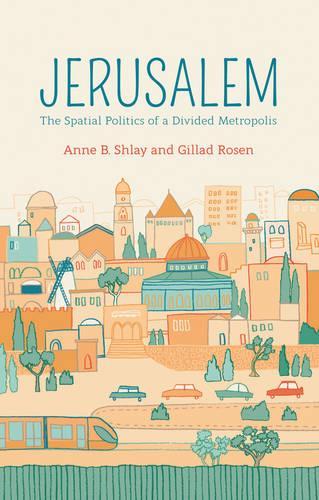
Jerusalem
Jerusalem
The Spatial Politics of a Divided Metropolis
Paperback
Couldn't load pickup availability
Join our rewards scheme and earn reward points on this purchase!
Earn points on this!
Sign in or Sign up!- Release Date: 29/05/2015
- Barcode: 9780745671048
- Genre: Society & Culture
- Sub-Genre: Politics & Government
- Imprint: Polity Press
- Publisher: John Wiley & Sons

Jerusalem
Couldn't load pickup availability
Collapsible content
DESCRIPTION
The Spatial Politics of a Divided Metropolis Jerusalem has for centuries been known as the spiritual center for the three largest monotheistic religions: Judaism, Christianity and Islam. Yet Jerusalem’s other-worldly transcendence is far from the daily reality of Jerusalem, a city bombarded by conflict. The battle over who owns and controls Jerusalem is intensely disputed on a global basis. Few cities rival Jerusalem in how its divisions are expressed in the political sphere and in ordinary everyday life.
Jerusalem has for centuries been known as the spiritual center for the three largest monotheistic religions: Judaism, Christianity and Islam. Yet Jerusalem s other-worldly transcendence is far from the daily reality of Jerusalem, a city bombarded by conflict.
Jerusalem: The Spatial Politics of a Divided Metropolis is about this constellation of competing on-the-ground interests: the endless set of claims, struggles, and debates over the land, neighborhoods, and communities that make up Jerusalem. Spatial politics explain the motivations and organizing around the battle for Jerusalem and illustrate how space is a weapon in the Jerusalem struggle. These are the windows to the world of the Israel-Palestine conflict.
Based on ninety interviews, years of fieldwork, and numerous Jerusalem experiences, this book depicts the groups living in Jerusalem, their roles in the conflict, and their connections to Jerusalem's development. Written for students, scholars, and those seeking to demystify the Jerusalem labyrinth, this book shows how religion, ideology, nationalism, and power underlie patterns of urban development, inequality, and conflict.
DELIVERY & RETURNS
UK Delivery:
- Free delivery on all orders of £10 or more.
- £1.49 delivery fee on orders below £10.
- UK orders are shipped via Royal Mail 2nd Class.
International Delivery:
- Flat rate delivery charges vary by country.
Dispatch and Delivery Times:
- All orders are shipped from our warehouse in Northampton, UK as soon as stock is available.
- UK mainland orders typically arrive within 3-7 working days via Royal Mail 2nd Class.
- International estimated delivery times:
- Europe & Channel Islands: 7 to 10 working days
- USA: 7 to 15 working days
- Rest of the World: 9 to 30 working days
View our full delivery infomation here.
-
OVER
2 MILLION PRODUCTS
-
60 MILLION CUSTOMERS
ACROSS 190 COUNTRIES
You might also like
Loading recommendations...